
“I’m on everything. Estrogen patch, progesterone, testosterone cream. My levels are good. So why is this my fourth UTI since Christmas?”
Some version of that lands in our clinic every week. The woman asking is doing everything right. She found a prescriber who says yes to hormones. She got her estradiol into range. Hot flashes gone, sleeping through the night, joints finally quiet, and she is deeply, specifically confused about why her bladder didn’t get the memo.
She isn’t doing anything wrong. Neither is her prescriber.
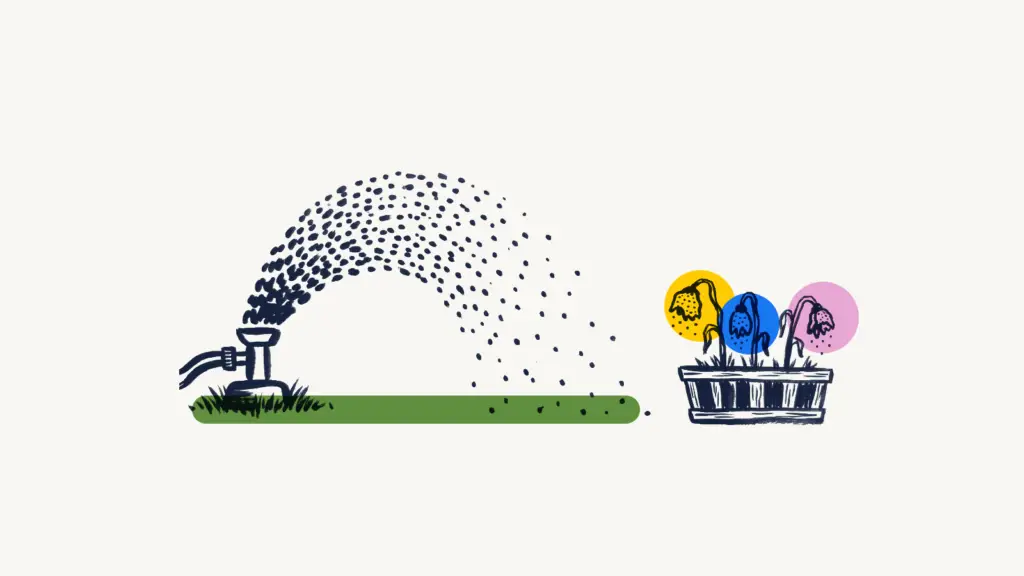
She’s watering the lawn with a sprinkler system and standing there wondering why the flower bed in the south corner is dead.
Menopause’s only lifetime contract
Until 2014 we called this vulvovaginal atrophy, a phrase apparently workshopped to guarantee no woman would ever say it out loud. “Atrophy” means shriveled. Nobody raises her hand in an exam room to volunteer that. So the menopause and sexual medicine societies renamed it genitourinary syndrome of menopause, GSM, which is clunky but puts the urinary half in the name where it belongs.
GSM is bigger than dryness. Burning, itching, pain with sex, tearing at the opening, loss of elasticity, urgency, frequency, the 2 a.m. trip to the bathroom, burning when you pee with no infection anywhere, and recurrent UTIs. Roughly half of postmenopausal women have some version of it.
And here’s the part that should change how you think about it. Hot flashes quit eventually. Most women burn through vasomotor symptoms and come out the other side. GSM keeps going, and it gets worse the longer the estrogen stays gone, because the tissue keeps thinning.
It’s one of the only menopause symptoms with a lifetime contract.
The sprinkler and the south lawn
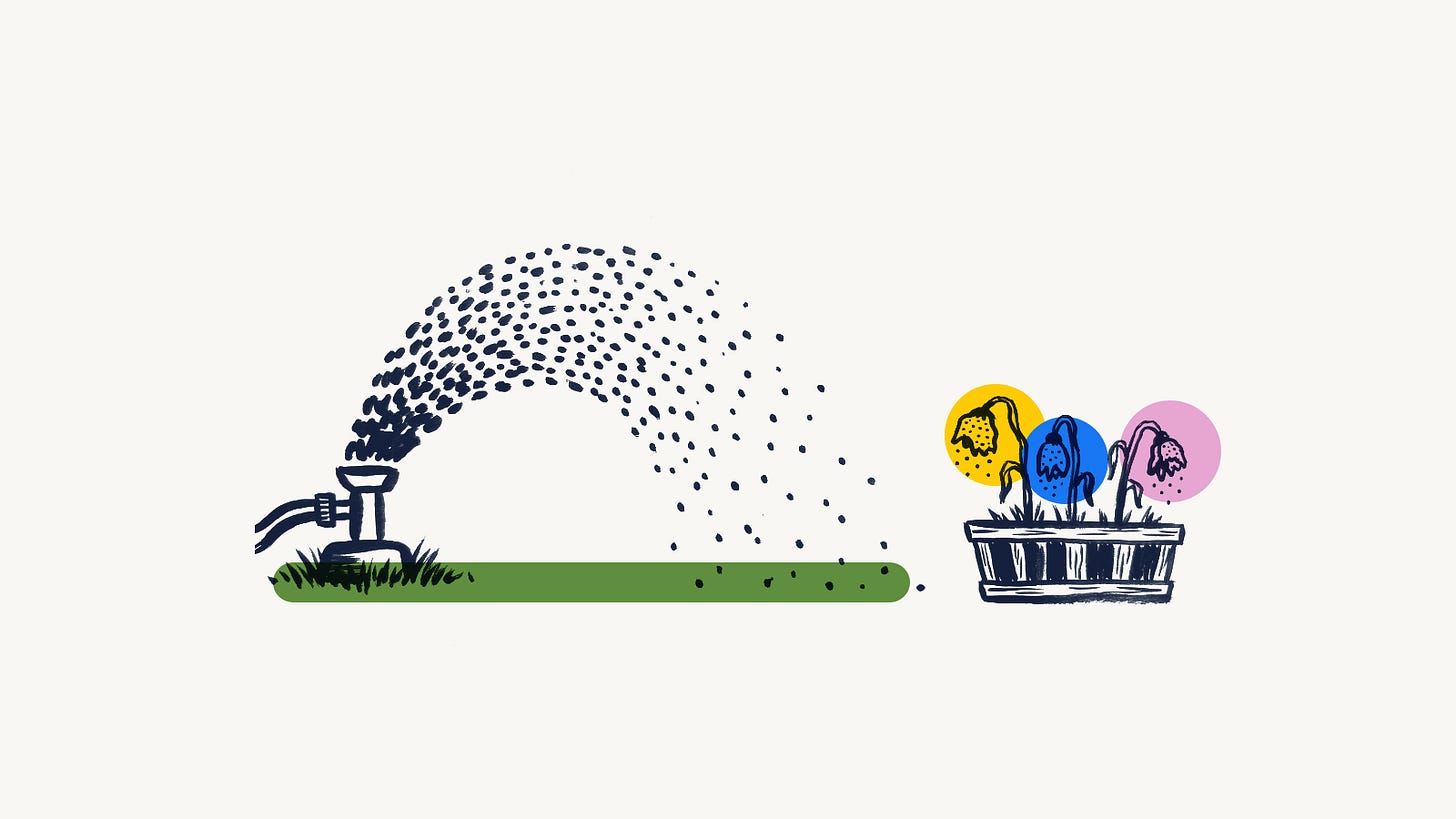
Systemic hormone therapy is your irrigation system. Patch, gel, pellet, tablet, injection: estradiol goes into your bloodstream, circulates, and every tissue with an estrogen receptor gets a drink. Bone, brain, blood vessels, skin, the vaginal wall. The coverage is impressive.
But every sprinkler has an arc. And there’s a bed of flowers in the south corner, tucked under the eave, that the spray may not saturate. Turn the pressure up. Run it twice as long. Stand in the yard and reason with it. The water still might not get there.
The urethra, the bladder trigone, and the vulvar vestibule are that flower bed. They’re loaded with estrogen receptors, which is exactly why they fall apart at menopause, and they respond to what you put ON them better than to what you put in your blood.
What the sprinkler does cover
Systemic estrogen earns its place. For hot flashes and night sweats it’s the most effective treatment that exists, and it’s doing work for your bones, blood vessels, metabolism, and brain that no vaginal preparation will ever touch.
Which brings us to the other tool, the one this whole piece is about. Vaginal estrogen is a tiny dose of estradiol delivered straight to the tissue: a cream, a soft insert, a tablet, or a ring you leave in for three months. It treats the neighborhood and stays there. Barely any of it shows up in your blood, which is why it has none of the systemic conversation attached to it.
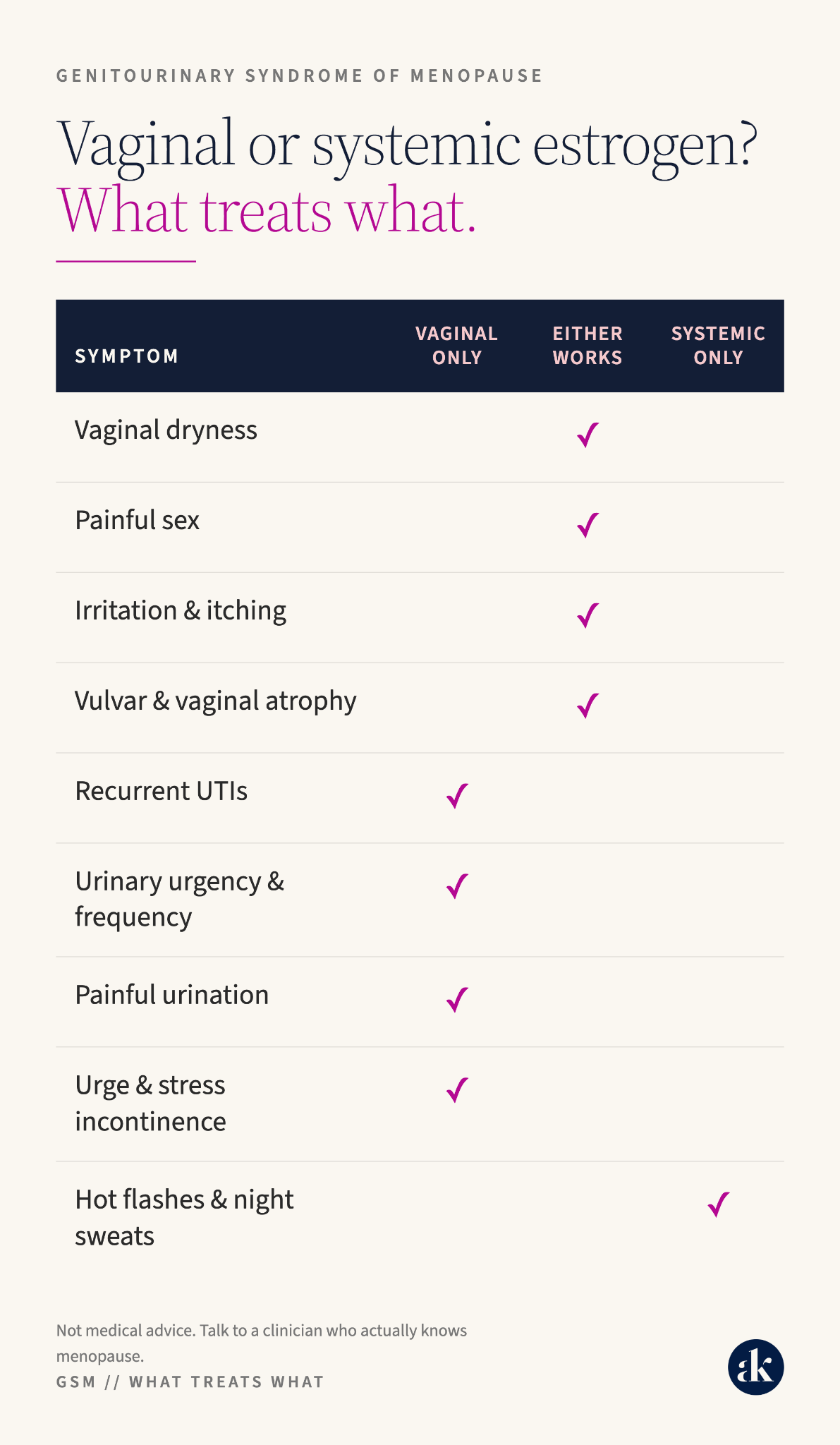
For vaginal dryness and pain with sex, both routes work, and neither one needs much. The lowest systemic dose studied for this, a 12.5 microgram estradiol patch, improves vaginal tissue. So does a 10 microgram vaginal tablet. Your vagina needs a teeny, tiny dose of estrogen to stay loosey-goosey, lubricated, and pain-free.
That’s the good news.
The spray-and-pray method works for some GSM symptoms. Not all of them.
Where the water never lands
For the urinary tract, low-dose vaginal estrogen beats systemic. Not by a little.
Vaginal estrogen roughly halves the risk of recurrent UTIs. That’s the cleanest finding in this whole literature, and it’s why the American Geriatrics Society names vaginal estrogen the preferred first-line option for recurrent UTIs. Systemic estrogen, in the same analyses, didn’t move the number at all.
Same story for leakage. For overactive bladder (the “I won’t make it to the bathroom in time” version) and stress incontinence (the “I can’t jump on a trampoline” version), vaginal estrogen cuts leakage by about a quarter and buys most women one to two fewer bathroom trips a day.
Your patch, meanwhile, isn’t doing much down there. It isn’t hurting your bladder. It also isn’t helping it.
The reason local wins is a neighborhood effect. Vaginal estrogen drops vaginal pH, brings the lactobacilli back, and displaces the gram-negative bacteria that colonize the area and then take a very short walk up a very short urethra. That requires estrogen in the neighborhood.
Interestingly, increasing your systemic dose doesn’t buy you the urinary benefit, which suggests this isn’t a dosing problem. It’s a go-get-the-pail problem. A serum estradiol of 100 doesn’t water the south bed any more than a lake three miles away waters your tomatoes.
One asterisk, and it’s Premarin
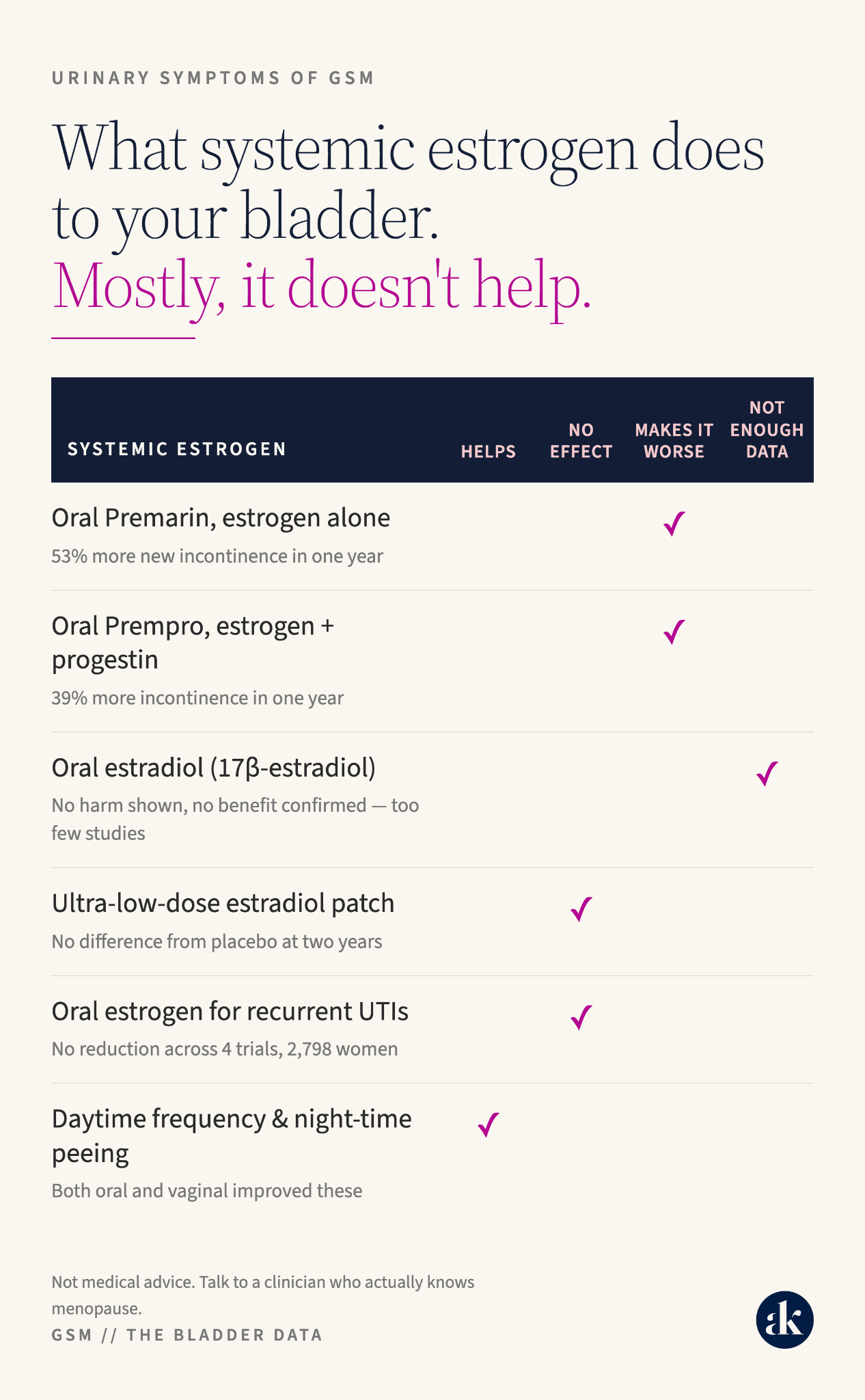
One exception, and it’s narrow. In the Women’s Health Initiative, women on oral conjugated equine estrogen (Premarin) were about 50% MORE likely to report new urinary incontinence than women on placebo. Before anyone blames the progestin, the estrogen-only arm had the larger signal.
Premarin is a mixture of at least ten estrogens pulled from pregnant mare urine, mostly estrone sulfate and equilin sulfate. Actual 17β-estradiol, the molecule your ovary made for forty years, is a few percent of the bottle at most. Several of those horse estrogens bind estrogen receptor beta more strongly than estradiol does, which is my best guess for why they behave differently in bladder tissue. What isn’t a guess: this has been shown for CEE, and no study has shown estradiol doing the same thing, by patch or by pill.
So if you’re on Premarin, that’s a reasonable conversation to have with your doctor. If you’re on estradiol, carry on. Either way, if you have continued GSM symptoms, the move is identical: add vaginal estrogen.
Hand-water your garden
Two practical notes.
First, put it where the problem is. Most women get handed an applicator and told to insert it, and that’s the whole instruction. This treats the vagina and skips the vestibule. The vestibule is the small patch of tissue at the entrance of the inner lips, surrounding both the vaginal and urethral openings. It’s different tissue than the vagina, loaded with receptors, and it’s where the burning, stinging, urgency, and tearing are coming from. The applicator shoots right past it.
So squeeze out a pea-sized amount of cream and use your finger. Rub it over the vestibule and the vulva, including right around the urethral opening (and don’t forget the clitoris!). Then put the rest in with the same finger. A finger goes where you point it; it costs nothing, and you don’t have to stand at the sink scrubbing out a plastic tube afterward. If you love your applicator, keep your applicator. Just do the vestibule and vulva by hand first.
Second, give it time. Apply vaginal estrogen two to three days a week, and the tissue takes one to three months to remodel. Check back at twelve weeks before you decide it isn’t working.

What about vaginal DHEA?
Vaginal DHEA is the other good option. It’s a precursor that vaginal cells convert on site into both estrogen and androgen, and for dryness and painful sex it performs about as well as vaginal estrogen. But, there’s more to this fascinating story. Full Substack on it next week.
In Summary…
If you have any genitourinary symptom, and I mean any single item on that list, you should be on vaginal estrogen or vaginal DHEA. Whether or not you’re on systemic hormones. Whether or not your levels look great. Whether or not it seems bad enough to bother mentioning.
If you’re on systemic estrogen and still dry, you’re in the 10 to 20% of women who stay dry on full-body estrogen.
If you’re getting UTIs, the patch won’t fix them. Add the local.
If you’ve had breast cancer, this is a conversation with your oncologist, and vaginal estrogen is not off the table. At all.
Your sprinkler is doing its job. It’s watering your bones, your brain, your blood vessels, and your skin, and it will keep doing that for as long as you let it.
The south lawn sits right at the edge of its reach.
Go get the watering can.
Tell me in the comments: Did anyone ever offer you vaginal estrogen, or did you have to go find it yourself? I already suspect the answer, and I want to see it in writing.
Amy
Sources
-
Cody JD, Jacobs ML, Richardson K, Moehrer B, Hextall A. Oestrogen therapy for urinary incontinence in post-menopausal women. Cochrane Database Syst Rev. 2012;10(10):CD001405. doi:10.1002/14651858.CD001405.pub3
-
Christmas MM, Iyer S, Daisy C, Maristany S, Letko J, Hickey M. Menopause hormone therapy and urinary symptoms: a systematic review. Menopause. 2023;30(6):672–685. doi:10.1097/GME.0000000000002187
-
Pinkerton JV, Vaughan MH, Kaunitz AM. Hormonal medications for genitourinary syndrome of menopause. Clin Obstet Gynecol. 2024;67(1):68–78. doi:10.1097/GRF.0000000000000835
-
Taithongchai A, Mohamed-Ahmed R, Sinha S, et al. Should hormone replacement therapy (any route of administration) be considered in all postmenopausal women with lower urinary tract symptoms? Report from the ICI-RS 2023. Neurourol Urodyn. 2024. doi:10.1002/nau.25384
-
Steinman MA, et al; AGS Beers Criteria Alternatives Panel. Alternative treatments to selected medications in the 2023 American Geriatrics Society Beers Criteria. J Am Geriatr Soc. 2025;73(9):2657–2677. doi:10.1111/jgs.19500
-
Danan ER, Sowerby C, Ullman KE, et al. Hormonal treatments and vaginal moisturizers for genitourinary syndrome of menopause: a systematic review. Ann Intern Med. 2024;177(10):1400–1414. doi:10.7326/ANNALS-24-00610
-
Crandall CJ, Mehta JM, Manson JE. Management of menopausal symptoms: a review. JAMA. 2023;329(5):405–420. doi:10.1001/jama.2022.24140
-
Hendrix SL, Cochrane BB, Nygaard IE, et al. Effects of estrogen with and without progestin on urinary incontinence. JAMA. 2005;293(8):935–948. (Pages confirmed.)
-
Waetjen LE, Brown JS, Vittinghoff E, et al. The effect of ultralow-dose transdermal estradiol on urinary incontinence in postmenopausal women. Obstet Gynecol. 2005;106(5 Pt 1):946–952. doi:10.1097/01.AOG.0000182576.48290.6d
-
Perrotta C, Aznar M, Mejia R, Albert X, Ng CW. Oestrogens for preventing recurrent urinary tract infection in postmenopausal women. Cochrane Database Syst Rev. 2008;(2):CD005131. doi:10.1002/14651858.CD005131.pub2
-
Mac Bride MB, Rhodes DJ, Shuster LT. Vulvovaginal atrophy. Mayo Clin Proc. 2010;85(1):87–94. doi:10.4065/mcp.2009.0413
-
Portman DJ, Gass MLS. Genitourinary syndrome of menopause: new terminology for vulvovaginal atrophy. Menopause. 2014;21(10):1063–1068. doi:10.1097/GME.0000000000000329
Are you a medical provider? Learn to prescribe hormone optimization therapy with the frameworks, protocols, and confidence you didn’t get in training.
Get Dr. Amy Killen’s Newsletter
Hormones, longevity, and regenerative medicine — straight talk from a physician who actually prescribes it. Free, weekly-ish, no spam.
This article was originally published on Dr. Amy Killen’s Substack newsletter. Subscribe for free to get new posts delivered to your inbox.