

The printout usually arrives folded in quarters.
She’s 52. She slides it across the desk and says, “My doctor says my cholesterol is fine.” Sometimes the doctor added “A little up, will monitor.” Sometimes nobody said anything at all, because every box was green.
Then we order an ApoB, and it comes back at 120-something.
Both numbers are correct. Only one of them is telling her the truth about her arteries. And the one telling the truth started climbing right around the time her periods stopped.
Welcome to the harbor
Cholesterol and triglycerides are fats, and fat doesn’t dissolve in blood. (Stir olive oil into water sometime. Same problem.) So your liver packs them into little boats called lipoproteins and ships them around the body. Big boats, medium boats, small boats, with names like VLDL, IDL, and LDL. HDL is a different kind of boat with a different job, and we’ll get to it.
Every boat that isn’t HDL gets strung with exactly one string of Christmas lights. That string is a protein called apolipoprotein B, or ApoB. One boat, one string. Never two, never zero. Count the lights and you’ve counted the boats.
That count is your ApoB.

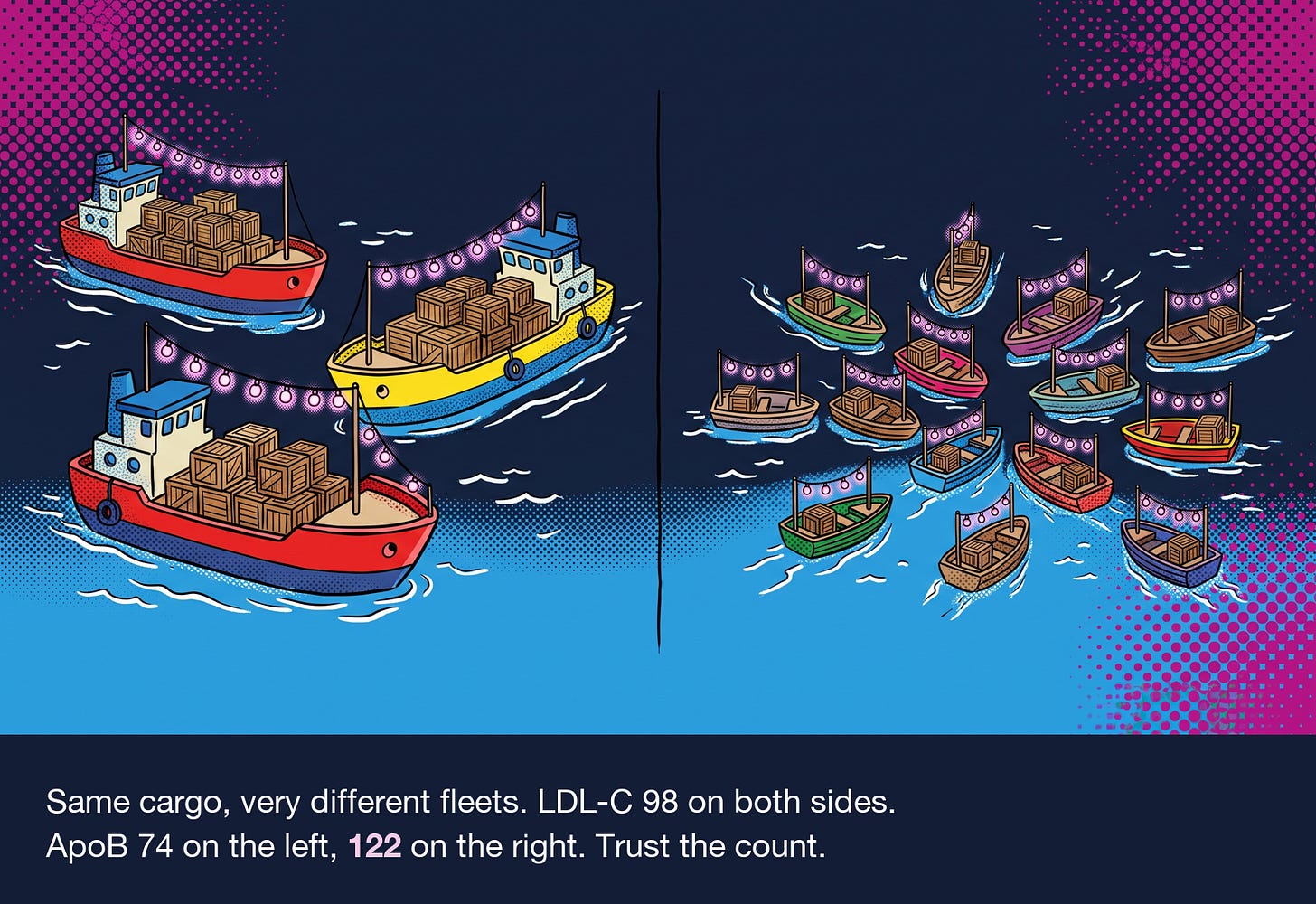
The standard cholesterol panel does something else entirely. Your LDL cholesterol (LDL-C) weighs the cargo. It tells you how much cholesterol is riding in LDL boats in total, and nothing about how many boats it’s spread across.
That distinction matters because the cargo doesn’t damage your arteries. The boats do. Boats bump along the artery wall all day, and some of them get shoved in and stuck. A stuck boat oxidizes, the immune system shows up to deal with it, and that’s the beginning of plaque. More boats in the water, more boats hitting the wall. Rush hour in the harbor.

LDL-C weighs the cargo. ApoB counts the boats. Plaque is a boat problem.
Most of the time cargo and count move together, and LDL-C does a passable job. But sometimes the same cargo gets split across many smaller boats. Same total cholesterol, twice the traffic. Your LDL-C looks fine. Your ApoB does NOT. Doctors call this discordance, and it shows up most in women with insulin resistance, high triglycerides, belly fat that arrived uninvited, and one more thing.
Midlife.
What menopause does to the harbor
The best data here comes from SWAN, the Study of Women’s Health Across the Nation, which followed thousands of women from before menopause through it and measured them every single year. In 2009, the SWAN investigators went after a question nobody had cleanly answered: when a woman’s cholesterol goes up in her late forties and fifties, is that aging, or is it menopause?
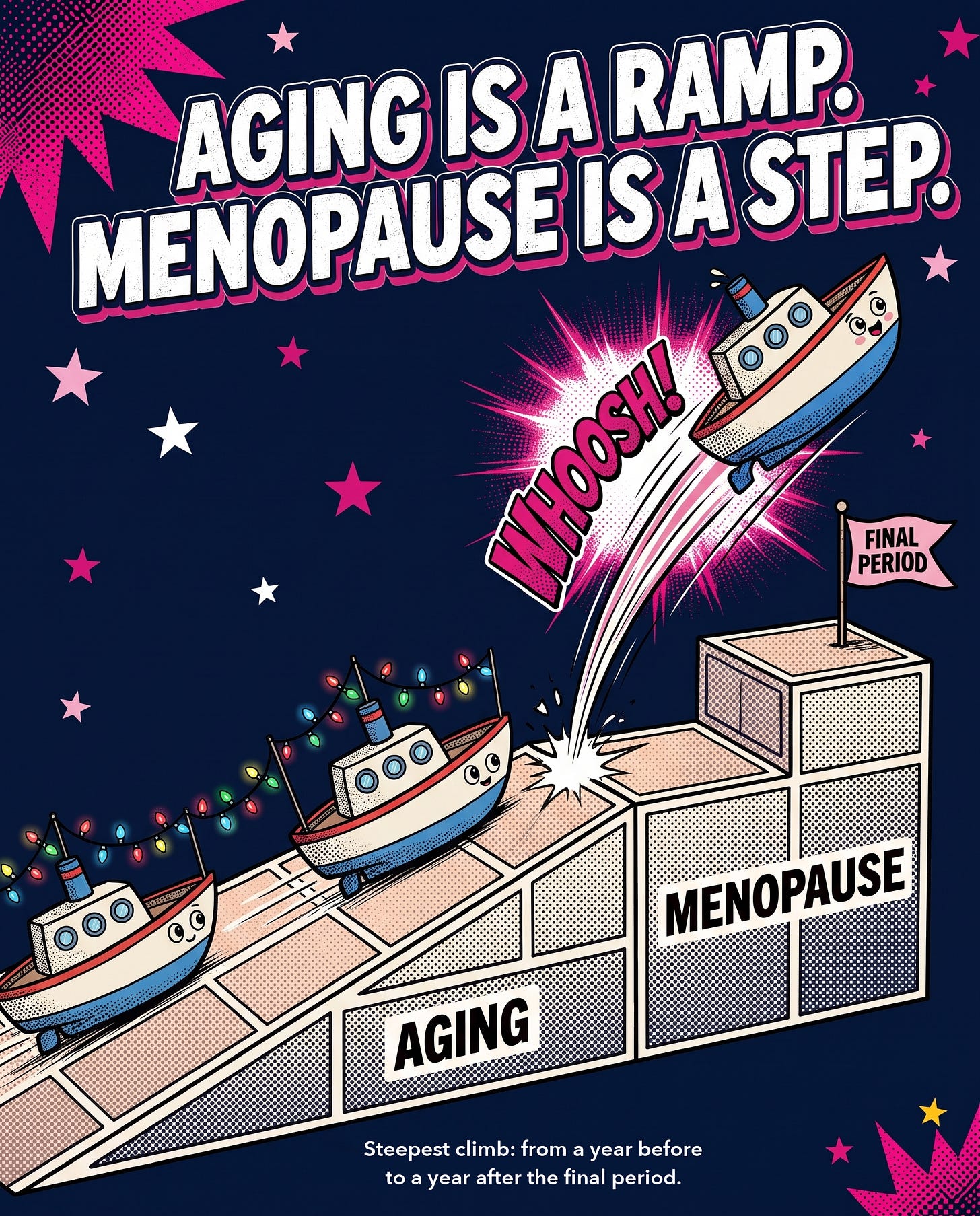
It was menopause. They tracked blood pressure, blood sugar, insulin, inflammation, clotting factors, and a full lipid panel, and only total cholesterol, LDL-C, and ApoB jumped specifically around the final period. The steepest climb happened in a two-year window, from about a year before a woman’s last period to about a year after. Then the numbers leveled off at their new, higher level and stayed there. The pattern held across ethnic groups and independent of age and weight gain.
Aging is a ramp. Menopause is a step.
That step carries forward. In a later SWAN analysis, the women whose LDL-C rose fastest around their final period had more plaque in their carotid arteries years afterward. It’s an observational association, not proof, but it points the same direction as everything else we know about boats and walls.
So why the step? Think of your liver as the harbor’s docks. It’s lined with LDL receptors, little moorings that pull LDL boats out of the water and break them down. Estrogen keeps more of those docks open. Back in 1991, a randomized study in the New England Journal of Medicine showed estrogen lowers LDL largely by speeding up how fast the liver clears it. Take estrogen away and docks close. Boats stay in the water longer. Traffic builds.

Meanwhile, the transition shifts fat toward the belly and nudges insulin resistance up, and LDL particles get smaller and denser across menopause. Smaller boats, less cargo each, more boats for the same amount of cholesterol. That’s discordance again, and it’s the part a standard panel undercounts.
So menopause hits ApoB twice. Fewer docks, and more boats per pound of cargo.
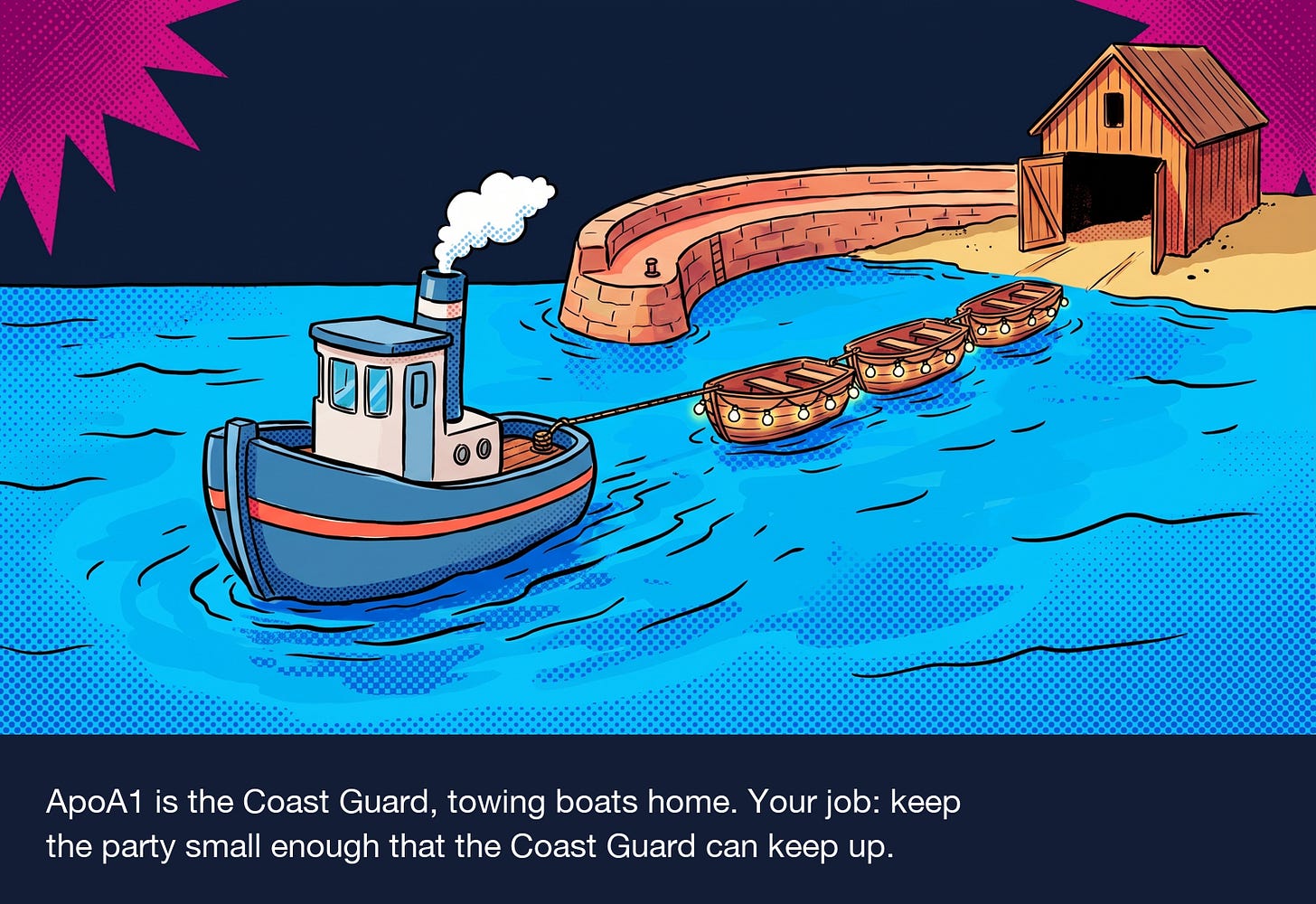
And the good boats? HDL carries its own protein, ApoA1, and I think of ApoA1 as the Coast Guard, towing cholesterol back toward the liver before it causes trouble. In SWAN, HDL and ApoA1 didn’t drop across the transition. The Coast Guard didn’t quit. It just clocked in one morning to find the harbor twice as crowded and nobody told it why.
What to do with this
Ask for ApoB. It’s a standard blood test, widely available, and inexpensive at most labs. Plenty of women in midlife have never had it run once.
Know what you’re aiming for. Most lab reference ranges don’t flag ApoB until somewhere around 130. I don’t use that. For most women, I want ApoB under 70, and lower (toward 40) with known plaque, a strong family history, or a high Lp(a), which we’ll get to in a minute. The 2026 ACC/AHA cholesterol guideline now sets ApoB goals of its own, which is a sentence I have been waiting a very long time to type.
Mind the date. If your last lipid panel was drawn at 46 and you’re now two years past your last period, that result describes a different harbor. Recheck.
What about hormone therapy? Estrogen reopens some of those docks. In clinical trials, oral estradiol lowers LDL-C by 15-20% while transdermal estradiol lowers it 5-10%. Oral estradiol also has a greater, positive effect on ApoB and HDL than transdermal (but a worse effect on triglycerides). And the lipid effects are modest in both groups. The route cuts both ways: oral estradiol does more for your lipids, and the patch has the cleaner clot profile. That’s a decision to make on purpose with your doctor, weighing your own risks.
If your ApoB is high, the heavy lifting comes from the usual suspects: fixing insulin resistance, losing visceral fat, moving your body, eating more fiber and less of the stuff that comes in crinkly bags, and when the numbers call for it, medication. The goal is simple. Fewer boats in the water.
The boat with a star on top
Now for the one you were born with.
Lp(a), pronounced “L-P-little-a,” is an LDL boat, Christmas lights and all, with something extra bolted on: a protein called apolipoprotein(a). Picture a big tree-topper star lashed to the deck.
That star causes two problems. First, it carries a cargo of oxidized fats that inflame the artery wall and drive calcification, including in the aortic valve, which nothing else on your lipid panel predicts. Second, its shape looks a lot like plasminogen, part of the body’s clot-dissolving crew, so it gets in the way of cleanup. Each star boat does more damage when it hits the wall, and the clot it leaves behind is harder to clear.
One trap before you read your own lab report. Apo(a), little a in parentheses, is the star. ApoA1 is the Coast Guard. Same letter, opposite meaning, and the lab usually prints them two lines apart. Squint accordingly.

Lp(a) behaves nothing like ApoB when it comes to menopause. Your level is roughly 80 to 90 percent genetic and largely set from birth. Diet doesn’t move it. Exercise doesn’t move it. In SWAN it didn’t even budge across the menopause transition.
Menopause adds boats. It doesn’t add stars. You were born with your stars.
About one in five people carry enough Lp(a) to raise their risk. Until this year, almost no guideline told anyone to look for it. The 2026 ACC/AHA guideline now recommends every adult have it measured at least once. Most of the women I meet have never had it checked.
What lowers it? Not much. Statins can nudge it up a little. Oral estrogen lowers it modestly, somewhere around 7 to 22% depending on the trial; the patch has been less consistent. Some injectable cholesterol drugs (PCSK9 inhibitors) bring it down about a quarter as a side effect.
For years, the big hope has been a new class of drugs built specifically to crush Lp(a). On September 4th, the first outcomes trial read out: pelacarsen, tested in more than 8,000 people who already had heart disease. Lp(a) went down. Heart attacks, strokes, and cardiovascular deaths did not. The genetics still say Lp(a) causes disease. The trial may mean lowering it late, in people who already have plaque, comes too late, or that this drug or dose wasn’t the right one. Other trials are still running. Where we stand today: we can lower Lp(a), and nobody has yet shown that lowering it prevents events.
So what do you do with a high number? You can’t take the star off the boat. So you take boats out of the water. A high Lp(a) means pushing ApoB lower than you otherwise would. It’s a reason to look at your arteries earlier, with a coronary calcium score or a CT angiogram, and find out whether they’ve already responded to a lifetime of star boats. And it’s a reason to pick up the phone, because roughly half of the siblings and children of someone with high Lp(a) have it too.
Tell your sister. Tell your kids.
Count the boats. Check for stars. Then go call your sister.
Sources
-
Matthews, Karen A., Sybil L. Crawford, Claudia U. Chae, et al. “Are Changes in Cardiovascular Disease Risk Factors in Midlife Women Due to Chronological Aging or to the Menopausal Transition?” Journal of the American College of Cardiology 54, no. 25 (2009): 2366–2373. doi:10.1016/j.jacc.2009.10.009
-
Matthews, Karen A., et al. “Lipid Changes Around the Final Menstrual Period Predict Carotid Subclinical Disease in Postmenopausal Women.” Stroke 48, no. 1 (2017): 70–76. doi:10.1161/STROKEAHA.116.014743
-
Walsh, Brian W., Isaac Schiff, Bernard Rosner, et al. “Effects of Postmenopausal Estrogen Replacement on the Concentrations and Metabolism of Plasma Lipoproteins.” New England Journal of Medicine 325, no. 17 (1991): 1196–1204. doi:10.1056/NEJM199110243251702
-
Carr, Molly C., et al. “Changes in LDL Density Across the Menopausal Transition.” Journal of Investigative Medicine 48, no. 4 (2000): 245–250.
-
“Oral, More Than Transdermal, Estrogen Therapy Improves Lipids and Lipoprotein(a) in Postmenopausal Women: A Randomized, Placebo-Controlled Study.” Menopause (2003). PMID 14627865.
-
“Effects of Oral and Transdermal Hormone Replacement Therapy on Lipoprotein(a) and Lipids: A Randomized Controlled Trial.” Menopause 5, no. 3 (1998).
-
Sniderman, Allan D., George Thanassoulis, Tamara Glavinovic, et al. “Apolipoprotein B Particles and Cardiovascular Disease: A Narrative Review.” JAMA Cardiology 4, no. 12 (2019): 1287–1295. doi:10.1001/jamacardio.2019.3780
-
Reyes-Soffer, Gissette, et al. “Lipoprotein(a): A Genetically Determined, Causal, and Prevalent Risk Factor for Atherosclerotic Cardiovascular Disease. A Scientific Statement from the American Heart Association.” Arteriosclerosis, Thrombosis, and Vascular Biology 42, no. 1 (2022): e48–e60. doi:10.1161/ATV.0000000000000147
-
2026 ACC/AHA Multisociety Dyslipidemia Guideline. Circulation (2026). doi:10.1161/CIR.0000000000001423
-
Novartis. “Novartis Announces Lp(a)HORIZON Phase III Topline Results for Pelacarsen in Patients with Elevated Lp(a) and Established Cardiovascular Disease.” Media release, September 4, 2026.
-
Cascade screening for Lp(a) in first-degree relatives. PMID 39259684.
Are you a medical provider? Learn to prescribe hormone optimization therapy with the frameworks, protocols, and confidence you didn’t get in training.
Get Dr. Amy Killen’s Newsletter
Hormones, longevity, and regenerative medicine — straight talk from a physician who actually prescribes it. Free, weekly-ish, no spam.
This article was originally published on Dr. Amy Killen’s Substack newsletter. Subscribe for free to get new posts delivered to your inbox.