This post covers lowest dose shortest duration. “We want the lowest effective dose for the shortest duration.”
You have heard this sentence. If you take estrogen, someone has said it to you across a desk. If you prescribe it, you may have said it to your patients.
It was printed on the label of every systemic estrogen product sold in this country. The FDA put it there in 2003 and built a public education campaign around it the same year. Medical societies picked it up. Residents learned it. Twenty-three years of women walked out of appointments carrying it home.
It is, at its heart, two claims in one sentence. The duration has at least some evidence behind it and deserves its own piece. This one is about the dose.
It sounds like a finding. It has the cadence of one. Which makes the following even more shocking: There has never been a trial behind it.
Not one randomized study assigned women to a higher dose of estrogen or a lower one and then counted the heart attacks, the strokes, the breast cancers, the deaths. Dose-ranging trials exist for hot flashes and thickening of the uterine lining, but those are different questions.
“Use the lowest dose” wasn’t a finding. It was a flinch, written down.
Then, in November 2025, the FDA asked drugmakers to remove it from the label. The boxed warning, too. The agency that wrote the sentence retracted the sentence. But nobody called the women (or, in many cases, their doctors).

Somebody taped a sign to the thermostat and left the building
Picture an office where the thermostat is set to 64 degrees and there’s a sign taped over it: DO NOT ADJUST. Everybody who works there has been cold for twenty-three years. They wear cardigans. They stopped complaining a long time ago. Nobody remembers who set the dial, nobody has read the sign closely in a very long time, and the man who taped it up doesn’t work here anymore.
Earlier this year, the FDA came through and peeled most of the sign off.
Everybody kept their cardigan on.
And here’s the part that should stay with you. For two decades, the label sitting in the box in your medicine cabinet admitted the whole problem out loud. It stated, in writing, that only one pill at one dose had ever been studied, and that whether any of it applied to other doses, or other delivery methods, or other products, was simply not known.
Then, on the same page, it instructed your doctor to use the lowest effective dose.
As in… We don’t know what other doses do. Now here’s which dose to use.
First, so we’re speaking the same language
You may already know some of this. I need it sitting right here where you can see it, because the rest of the piece doesn’t work without it.
There are two hormones in the conversation, not one.
Estrogen does most of the work you actually care about. Hot flashes, sleep, bones, brain, skin. It comes in two flavors. The older kind is made from horse urine and swallowed as a pill. That’s the one sold as Premarin, and it’s the one nearly every scary headline you’ve ever read was actually about. The newer kind is estradiol, which is molecularly identical to the estrogen your own ovaries made for thirty years. It comes as a pill, a patch, a gel, or a spray that goes through your skin.
That last distinction matters more than almost anything else here, so let me give you the word for it. Transdermal just means “through the skin.” A patch is transdermal. A pill is not. Hold onto that.
Progestogen is the second hormone, the one you take to protect your uterus from estrogen. And this is where the whole story turns, because “progestogen” is an umbrella covering two completely different drugs.
Under that umbrella sits progesterone, the molecule your own body made every month for three decades. And next to it sit the progestins, the synthetic knockoffs invented in a lab.
They get lumped together on labels, in studies, and in the way your doctor talks about them. They are not the same drug. Which one you were handed turns out to matter enormously more than how much estrogen you were handed.
That’s the whole ballgame. It’s coming.
And one more thing, because none of the numbers below mean anything without it. When I say low dose and high dose, here’s the ruler I’m using, for estradiol patches:
-
0.014 – 0.025 mg/day. The lowest ones.
-
0.05 mg/day. The middle of the road (aka: 50 mcg/day)
-
0.1 mg/day. The top of the FDA-approved range. (aka: 100 mcg/day)
Three settings on a dial. That’s it. That’s the entire argument we’ve spent twenty-three years having.
Note: for more information on dosing and how different types of estrogen affect your serum estradiol level, see my previous Substack “Why Won’t Anybody Tell Me the Optimal Estradiol Level in Menopause??”)
Breast cancer: separating facts from fear
A quick word about the state of the evidence, because I don’t want to oversell my own position. The randomized trials, including the Women’s Health Initiative, have not shown estrogen alone to increase breast cancer risk at all. Some large observational studies that track women in the real world rather than assigning them to treatment do point to an increase. Why those two bodies of evidence disagree is a genuinely interesting fight, and the book Estrogen Matters by Avrum Bluming handles it better than I could in a newsletter (go read that book).
I’m asking a narrower question. Set aside whether estrogen raises breast cancer risk at all. If it does, does the dose change the risk?
The largest collection of breast cancer data ever assembled on hormone therapy (Collaborative Group, Lancet, 2019) pooled individual records on women from all over the world. Buried deep in its appendix is a table almost nobody has ever discussed: breast cancer, broken out by estrogen dose. The authors ran the numbers. They printed them. And then they never analyzed them, never charted them, and never mentioned them again.
So I ran the comparison they didn’t.
Standard dose compared to above-standard dose. Nearly seventeen hundred breast cancers between them. The risk is the same. Straight up and down, with more than enough women in that comparison that even a modest increase would have surfaced (see my graph below).
Then there’s the low dose.
The lowest dose of conjugated estrogen in that table is the one group that stands apart, and it does not stand where the doctrine says it should. It sits HIGHER. The dose women were told to take for their safety carries the highest breast cancer signal on the chart, and the doses they were warned away from are flat.
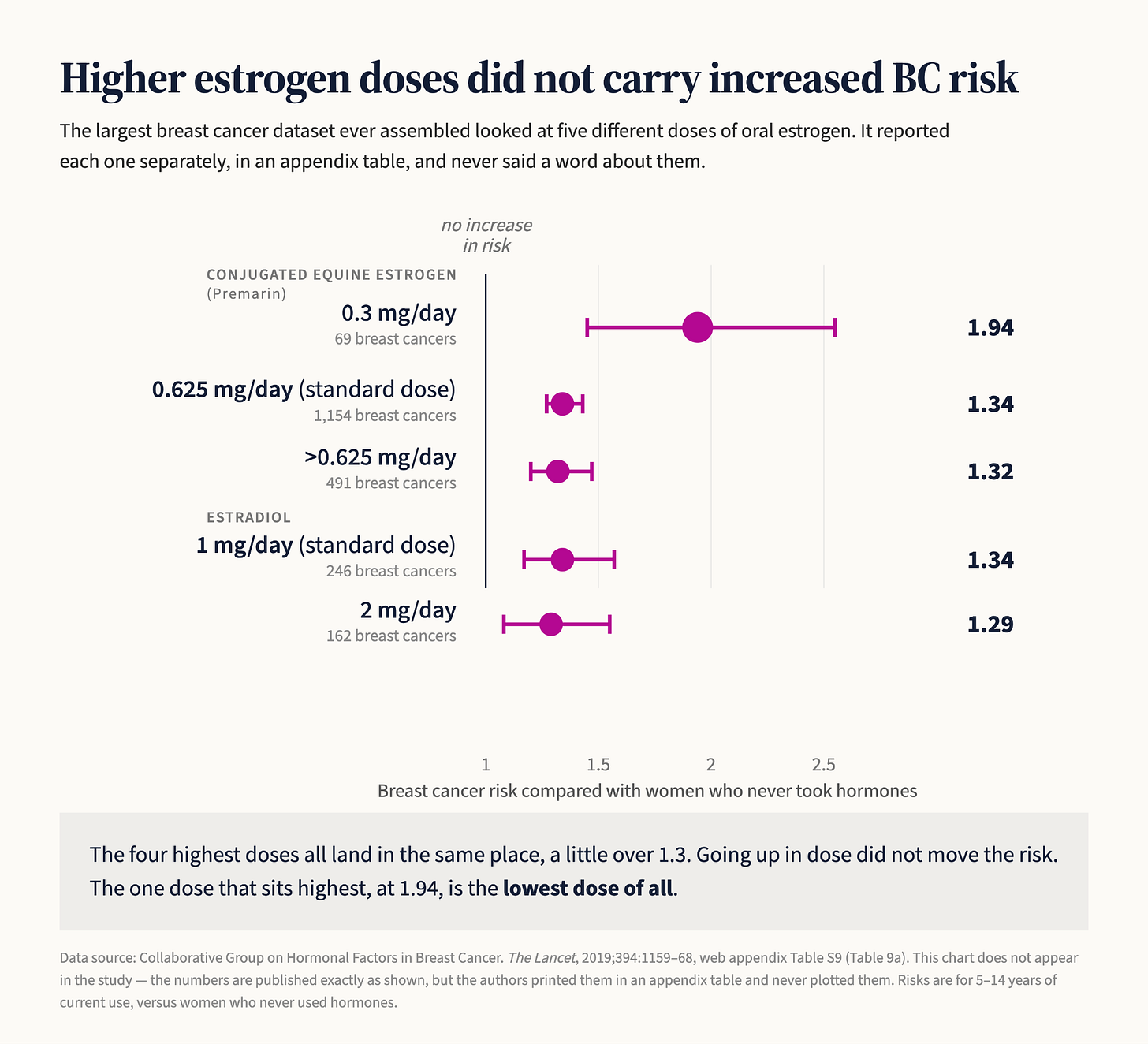
I am not going to tell you that low-dose estrogen causes breast cancer. I don’t believe that, and a single subgroup in an appendix isn’t the kind of evidence that should convince anyone of anything. There are ordinary explanations available. Older women get started on lower doses. Women with risk factors get started on lower doses. Sicker women get watched more closely.
But notice what just happened. I found a number that cuts against the official story, and my first instinct was to explain it away with confounding. That instinct is correct. It’s also the exact courtesy nobody extended in the other direction for twenty-three years.
And when researchers have gone looking for a dial that actually moves breast cancer risk, they haven’t found it on the estrogen dose. They’ve found it on the progestogen type, where synthetic progestins carry a risk that body-identical progesterone doesn’t (E3N).
That’s the dial. It has been sitting in plain sight the entire time, and for twenty-three years, we’ve been frantically cranking the other one.
Blood clots, your liver has thoughts
The second thing they warn you about is a blood clot. And here the dose question turns out to be the wrong question altogether.
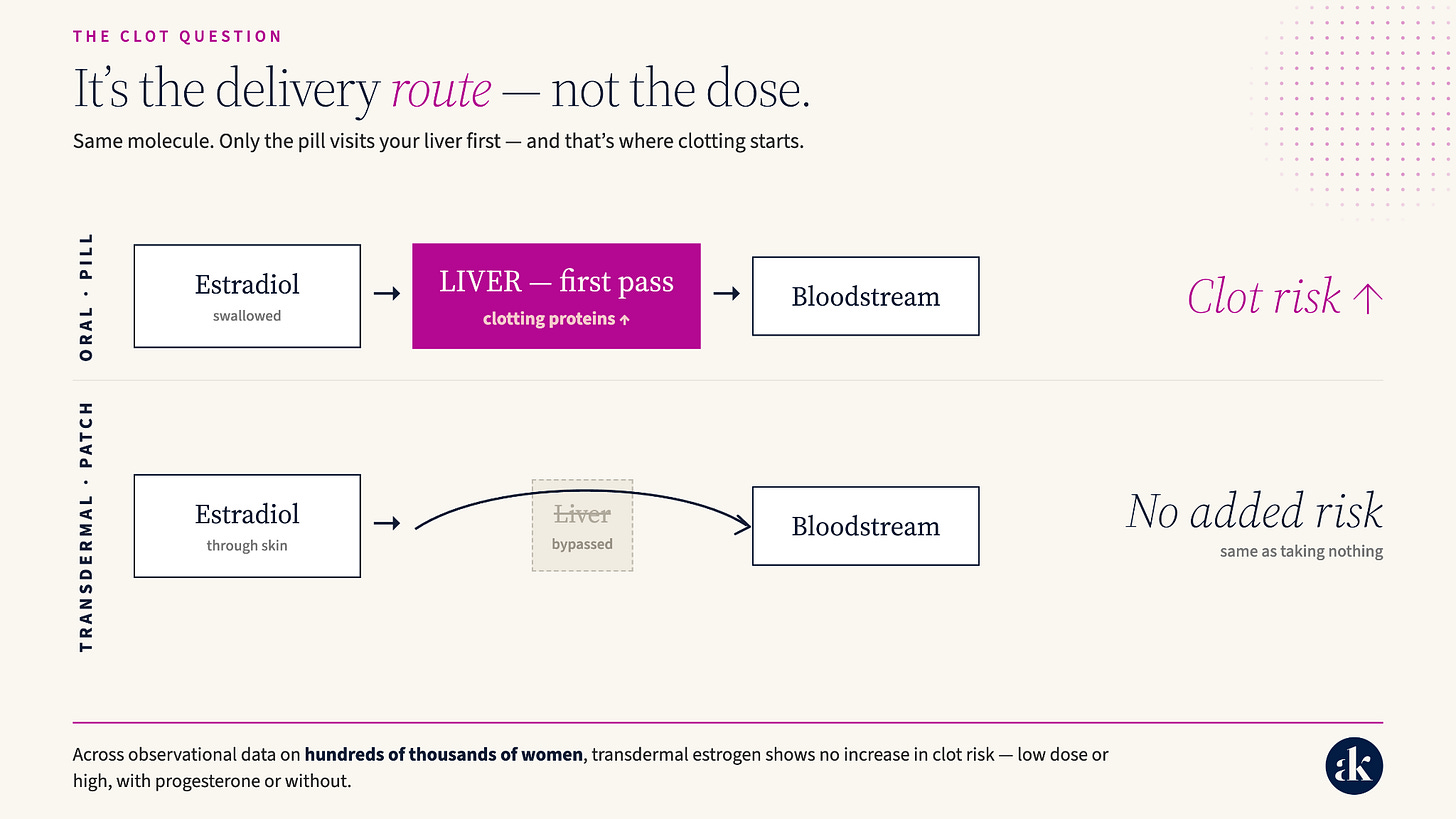
When you swallow estrogen, it goes to your liver before it goes anywhere else. Your liver has no idea it’s being medicated. It just notices a large slug of hormone arriving through the front door, and it responds the way it always does, by cranking up production of the proteins that make blood clot.
That’s the whole mechanism. It isn’t mysterious, and it has very little to do with how much.
A patch doesn’t do this. It goes through your skin, into your bloodstream, and never makes that first stop at the liver at all.
And the data land exactly where the mechanism says they should. Across observational studies covering hundreds of thousands of women, estrogen through the skin shows no increase in clot risk. Not at low doses. Not at high ones. Not with progesterone and not without.
So the clot warning that has followed you around, the one on the box, the one your sister mentioned at Thanksgiving, is a warning about a delivery route. Somewhere along the way, it got generalized to the whole molecule.
Your patch is not the pill. And the dose of your patch was never the thing that mattered.
Your heart
High doses of swallowed horse estrogen (Premarin) may increase heart disease more than lower doses, but even that was only in late-starters.
Estradiol is a different story, and the dose runs backward.
No trial of estradiol, swallowed or through the skin, has ever shown an increase in heart disease. A Danish trial (DOPS) followed a thousand women around age 50 and found roughly half the risk of heart failure, heart attack, and death a decade later. Two other trials asked nearly the same question of women recently past menopause: the one using a higher dose of estradiol (ELITE) slowed arterial thickening, and the one using a low dose estradiol (KEEPS) did nothing. When the American Heart Association wrote up why the two disagreed, they said the difference may well have been the dose (as in, the HIGHER dose was associated with LOWER heart disease).
All of this holds for women who start early, within a few years of menopause, and it fades for women who start ten or more years out.
Stroke, and the twenty-seven women
Stroke is the last card anyone plays here, so let’s turn it over.
There’s one place the caution genuinely holds up. Women swallowing the horse-urine pills (Premarin), the ones from the original WHI trial, do show more strokes at higher doses. That’s a real finding. If you’re taking that drug by mouth, “lowest effective dose” may be perfectly sound advice.
But the moment you switch to estradiol through the skin, the story falls apart.
“But what about the Renoux study? The one that showed high-dose transdermal estradiol is associated with stroke? Doesn’t that support ‘lowest effective dose’?”
A 2010 study (Renoux) reported a higher stroke risk in women on higher-dose patches, and that single finding walked straight into the guidance that governs how your doctor thinks about your patch today. I’ve written about this study at length before, because it deserves it (see “The Stroke Excuse”). Here’s the short version.
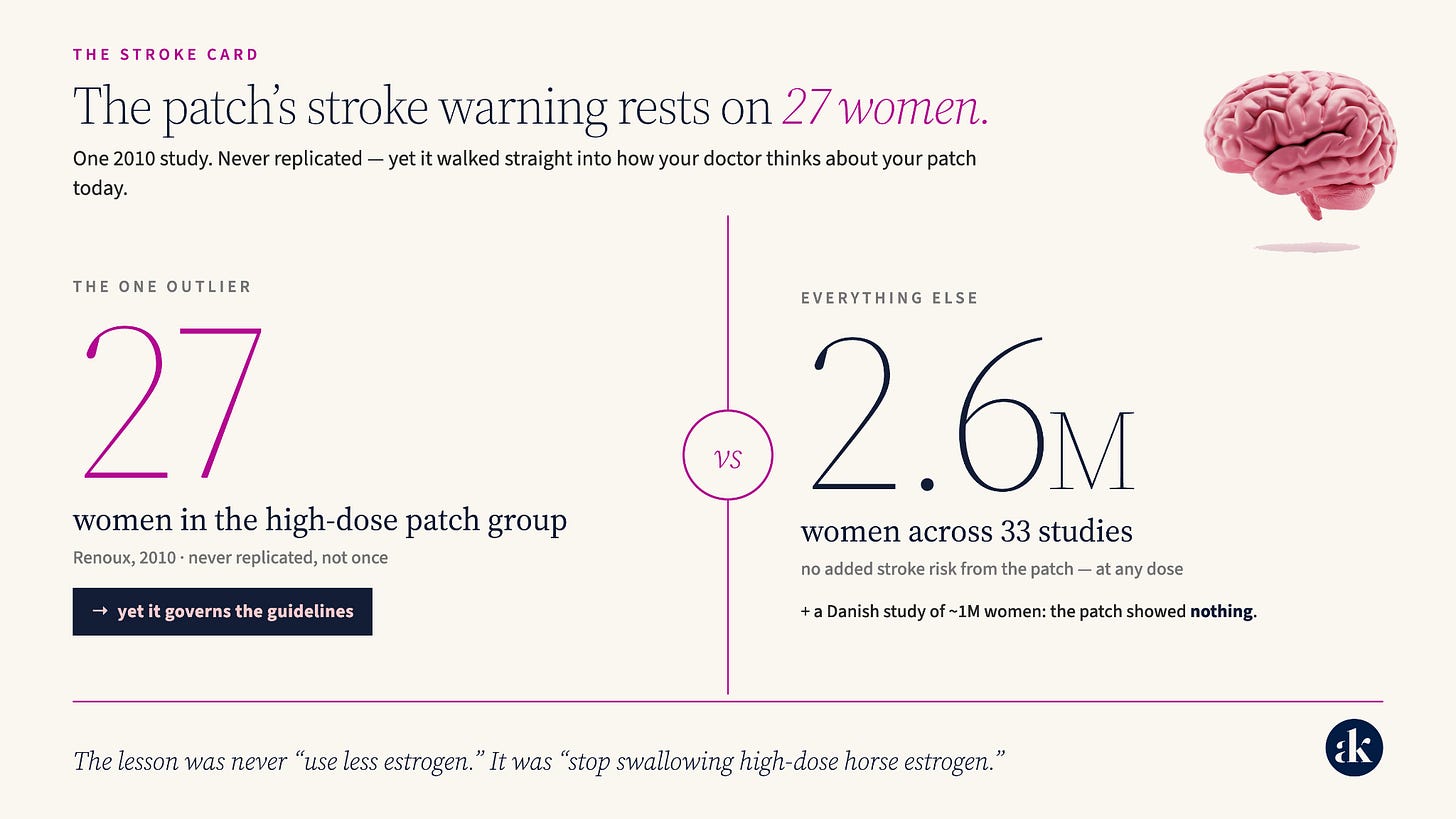
The study compared roughly 15,000 stroke victims against 60,000 controls. Impressive numbers. But how many women were actually in that high-dose patch group, the group the entire warning rests on?
Twenty-seven.
Not twenty-seven thousand. 27 women. The uncertainty around that result was wide enough to stretch from “barely there” to “nearly triple,” which is a technical way of saying the study didn’t know.
And it never accounted for the most obvious explanation on the table. Who gets put on the higher doses? The women with the worst hot flashes, the worst night sweats, the worst brain symptoms. Severe hot flashes are themselves a risk factor for stroke. The study never separated the women from their symptoms. It just handed the blame to the patch.
It has never been replicated. No other study of estradiol through the skin has found that a higher dose carries a greater stroke risk.
Meanwhile, a Danish study followed nearly a million women and recorded more than 20,000 strokes. Oral estrogen raised the risk. Vaginal estrogen lowered it. The patch showed nothing. And a 2019 review, pooling 33 studies and 2.6 million women, found no increased stroke risk with the patch at any dose, anywhere outside the Renoux paper.
Twenty-seven women against 2.6 million. Guess which one made it into the guidelines?
The lesson of the stroke literature was never “use less estrogen.” It was “stop swallowing high-dose horse estrogen.”
Where the estrogen dose really DOES matter
I’m not here to tell you the dose is meaningless. It matters in two directions.
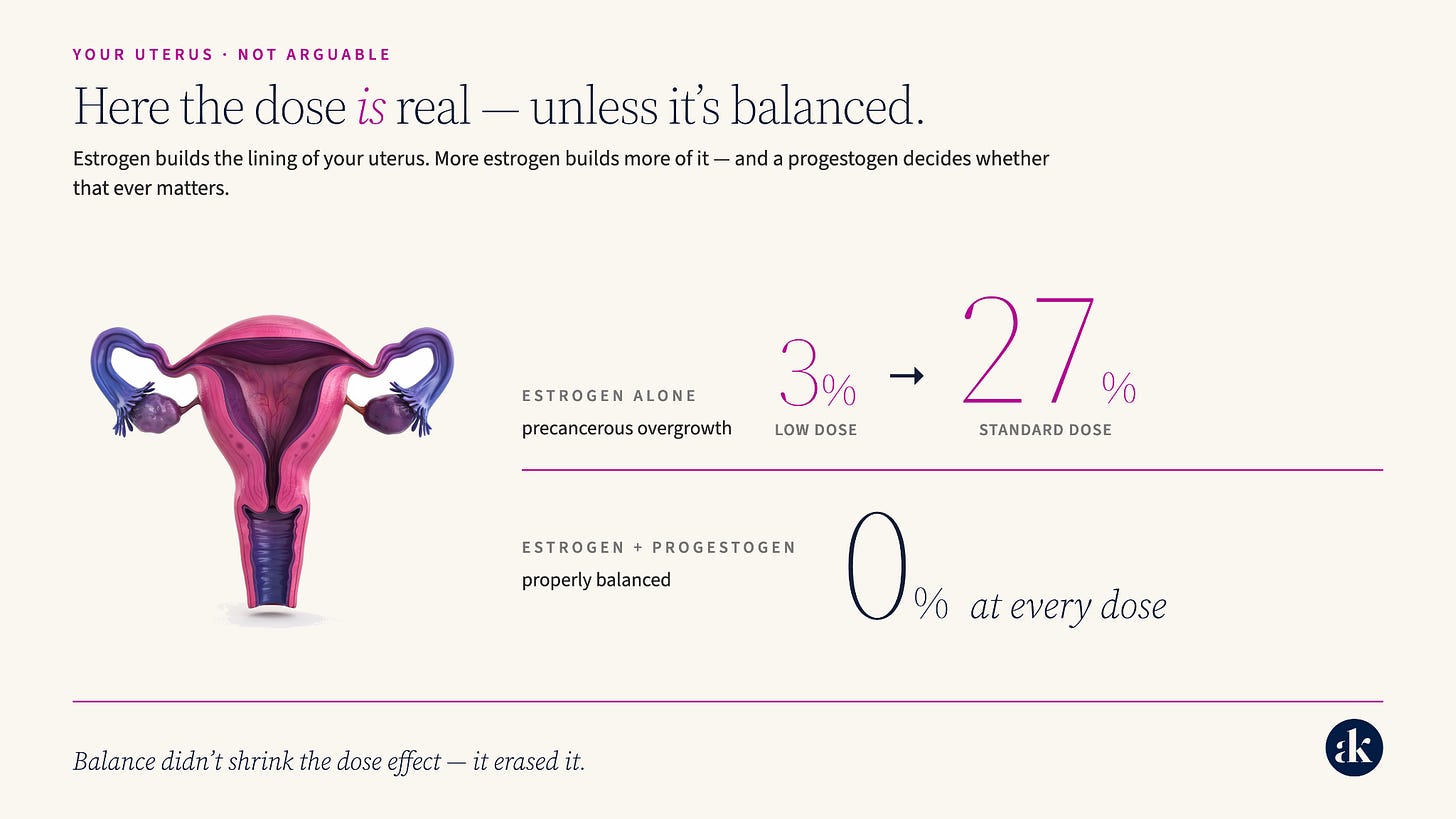
It matters for your uterus, and this one isn’t arguable.
Estrogen builds the lining of your uterus, and more estrogen builds more of it. In one trial, women given estrogen with nothing to balance it developed precancerous overgrowth about three percent of the time on a low dose, and twenty-seven percent of the time on a standard dose. That is a steep, ugly, unmistakable dose effect. It’s exactly why the FDA left that as the only warning on the label, and they were right to do so.
But look at what happened in the groups where the estrogen was properly balanced with a progestogen. The rate of overgrowth was zero. At every single estrogen dose.
Adequate protection didn’t shrink the dose effect. It erased it.
Which gives us something sharper than where we started. Every single place the dose looks dangerous, the danger turns out to belong to something else in the regimen. Not to the estrogen itself. To what it was paired with, or how it was delivered.
And the estrogen dose matters for the benefits
Symptoms. Higher doses simply work better for most women. About half of women get real relief from hot flashes and night sweats on the lowest dose. Nearly nine in ten do at a medium dose. Low doses are also slow, taking 8 to 12 weeks to work, rather than 2 to 4.
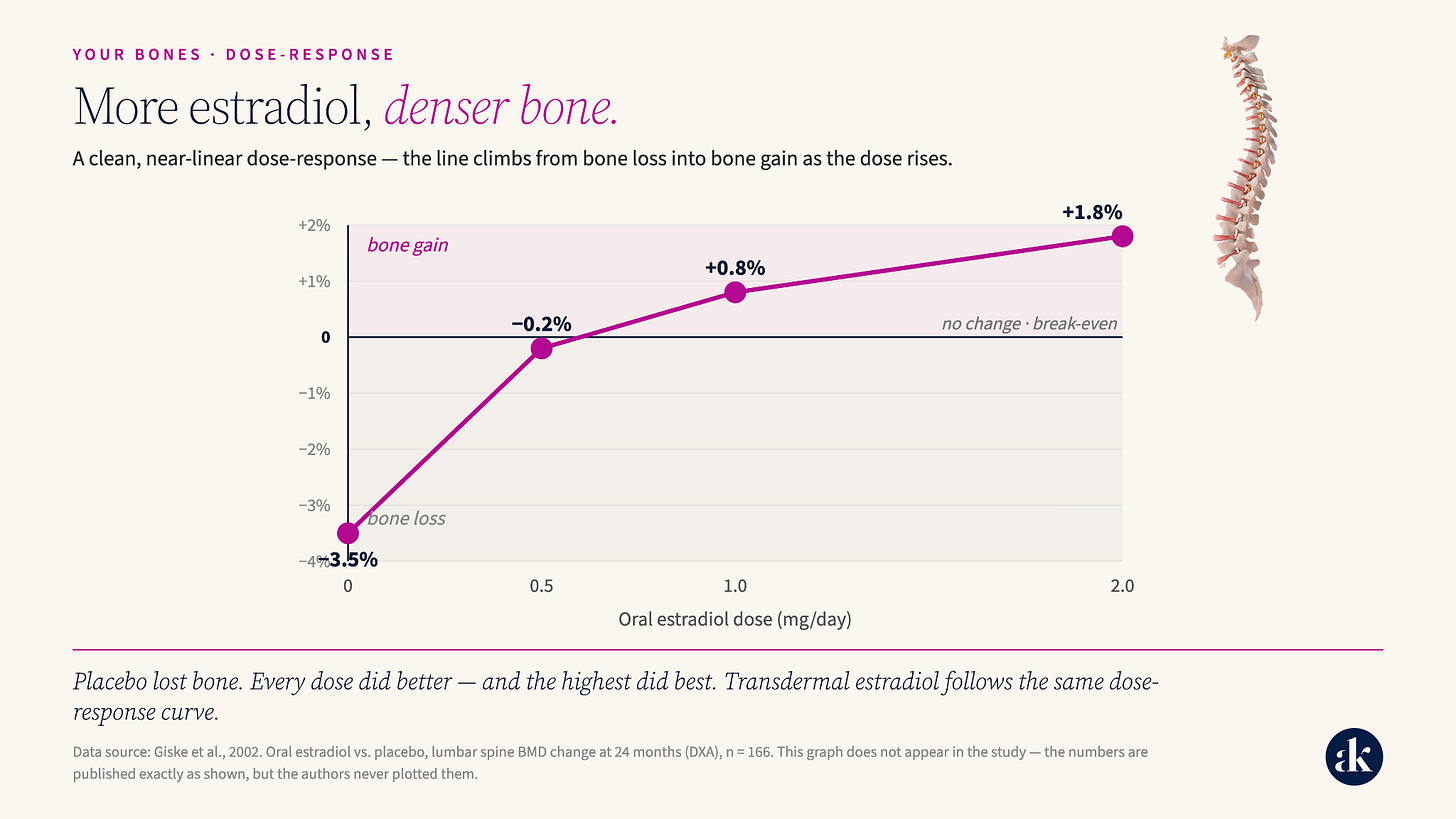
Bone. Lower doses of estrogen can help prevent bone loss, but higher doses are needed to build bone. There’s a clear dose response for estrogen and bone building (higher is better). See my article “Bon Appétit” for more on this.
Cholesterol. In newly menopausal women, higher doses of estradiol lower LDL and raise HDL more than lower doses (REPLENISH trial).
Heart. Higher plasma estradiol levels were inversely associated with thickening of the arterial wall in the post-trial analysis of the ELITE study, as in… women who achieved higher estradiol levels had less wall thickening (this was true only in the group that started hormones within 6 years of menopause onset, not in the late-start group).
Two things before you go
One. If estrogen rises, the progestogen rises with it.
This is not a footnote, and it is not optional. Everything I’ve told you about the estrogen dial being safe to turn assumes that the uterus is properly protected, and “properly” means the second hormone scales up, too.
Two. We are talking about doses inside the approved range.
Everything above lives between that 0.014 and that 0.1 mg/day patch (or its equivalent). I am not talking about the very high-dose pellets and compounded creams that push blood levels to 200, 300, 400 pg/mL and beyond. I can’t tell you they’re safe in the long term, or that they’re dangerous, because the research simply doesn’t exist.
In summary
I went looking for the study behind the rule they’ve been reciting for two decades.
Lowest dose. Shortest duration.
It doesn’t exist.
We had the money. We had the women. We had the follow-up. We never once put the dose question and the outcome question in the same room.
So we skipped the research and told women to take less. Never mind that outside the uterus, the observational data don’t show low doses protecting anyone from anything. Never mind that where we do have dose-response data – bone density, cardiovascular disease, and the severity of symptoms themselves – it runs the other direction. More works better.
If your clinician pulls out the old line about wanting to use the lowest effective dose, ask her where that sentence came from. Ask her to show you the evidence that a lower dose of estrogen is safer than a higher dose.
And do not – for a single day longer – let yourself be afraid of a 100 mcg patch because someone repeated a rule that nobody ever tested.
Tell me in the comments. If you’re on hormones, were you ever told where “lowest effective dose” came from, or was it just handed to you like weather? And if you prescribe them: what dose do you start at, and can you say why? I read every one.
References
-
Collaborative Group on Hormonal Factors in Breast Cancer. Type and timing of menopausal hormone therapy and breast cancer risk: individual participant meta-analysis of the worldwide epidemiological evidence. Lancet. 2019;394(10204):1159-1168. PMID 31474332. DOI 10.1016/S0140-6736(19)31709-X.
-
Fournier A, Fabre A, Mesrine S, Boutron-Ruault MC, Berrino F, Clavel-Chapelon F. Unequal risks for breast cancer associated with different hormone replacement therapies: results from the E3N cohort study. Breast Cancer Res Treat. 2008;107(1):103-111. PMID 17333341. DOI 10.1007/s10549-007-9523-x.
-
Fournier A, Berrino F, Riboli E, Avenel V, Clavel-Chapelon F. Breast cancer risk in relation to different types of hormone replacement therapy in the E3N-EPIC cohort. Int J Cancer. 2005;114(3):448-454. PMID 15551359.
-
Vinogradova Y, Coupland C, Hippisley-Cox J. Use of hormone replacement therapy and risk of venous thromboembolism: nested case-control studies using the QResearch and CPRD databases. BMJ. 2019;364:k4810. PMID 30626577. DOI 10.1136/bmj.k4810.
-
Renoux C, Dell’Aniello S, Garbe E, Suissa S. Transdermal and oral hormone replacement therapy and the risk of stroke: a nested case-control study. BMJ. 2010;340:c2519. PMID 20525678. DOI 10.1136/bmj.c2519.
-
Løkkegaard E, Nielsen LH, Keiding N. Risk of stroke with various types of menopausal hormone therapies: a national cohort study. Stroke. 2017;48(8):2266-2269. PMID 28626058. DOI 10.1161/STROKEAHA.117.017132.
-
Oliver-Williams C, Glisic M, Shahzad S, et al. The route of administration, timing, duration and dose of postmenopausal hormone therapy and cardiovascular outcomes in women: a systematic review. Hum Reprod Update. 2019;25(2):257-271. PMID 30508190. DOI 10.1093/humupd/dmy039.
-
Schierbeck LL, Rejnmark L, Tofteng CL, et al. Effect of hormone replacement therapy on cardiovascular events in recently postmenopausal women: randomised trial. BMJ. 2012;345:e6409. DOI 10.1136/bmj.e6409.
-
Hodis HN, Mack WJ, Henderson VW, et al. Vascular effects of early versus late postmenopausal treatment with estradiol. N Engl J Med. 2016;374(13):1221-1231. PMID 27028912. DOI 10.1056/NEJMoa1505241.
-
Sriprasert I, Hodis HN, Karim R, Stanczyk FZ, Shoupe D, Henderson VW, Mack WJ. Differential effect of plasma estradiol on subclinical atherosclerosis progression in early vs late postmenopause. J Clin Endocrinol Metab. 2019;104(2):293-300. PMID 30272234. DOI 10.1210/jc.2018-01600.
-
Harman SM, Black DM, Naftolin F, et al. Arterial imaging outcomes and cardiovascular risk factors in recently menopausal women: a randomized trial. Ann Intern Med. 2014;161(4):249-260. PMID 25069991.
-
El Khoudary SR, Aggarwal B, Beckie TM, et al. Menopause transition and cardiovascular disease risk: implications for timing of early prevention. A scientific statement from the American Heart Association. Circulation. 2020;142(25):e506-e532. DOI 10.1161/CIR.0000000000000912.
-
Pickar JH, Yeh IT, Wheeler JE, Cunnane MF, Speroff L. Endometrial effects of lower doses of conjugated equine estrogens and medroxyprogesterone acetate: two-year substudy results. Fertil Steril. 2003;80(5):1234-1240.
-
Giske LE, Hall G, Rud T, Landgren BM. The effect of 17β-estradiol at doses of 0.5, 1 and 2 mg compared with placebo on early postmenopausal bone loss in hysterectomized women. Osteoporos Int. 2002;13(4):309-316. PMID 12030546. DOI 10.1007/s001980200031.
-
Ettinger B, Genant HK, Steiger P, Madvig P. Low-dosage micronized 17β-estradiol prevents bone loss in postmenopausal women. Am J Obstet Gynecol. 1992;166(2):479-488. DOI 10.1016/0002-9378(92)91653-R.
-
Weiss SR, Ellman H, Dolker M; Transdermal Estradiol Investigator Group. A randomized controlled trial of four doses of transdermal estradiol for preventing postmenopausal bone loss. Obstet Gynecol. 1999;94(3):330-336. PMID 10472854.
-
Delmas PD, Pornel B, Felsenberg D, Garnero P, Hardy P, Pilate C, Dain MP; International Study Group. A dose-ranging trial of a matrix transdermal 17β-estradiol for the prevention of bone loss in early postmenopausal women. Bone. 1999;24(5):517-523. PMID 10321913. DOI 10.1016/s8756-3282(99)00076-9.
-
Sriprasert I, Hodis HN, Bernick B, Mirkin S, Mack WJ. Effects of estradiol dose and serum estradiol levels on metabolic measures in early and late postmenopausal women in the REPLENISH trial. J Womens Health (Larchmt). 2020;29(8):1052-1058. PMID 32644875. DOI 10.1089/jwh.2019.8238.
-
Lobo RA, Archer DF, Kagan R, et al. A 17β-estradiol-progesterone oral capsule for vasomotor symptoms in postmenopausal women: a randomized controlled trial. Obstet Gynecol. 2018;132(1):161-170. PMID 29889748.
-
U.S. Food and Drug Administration. FDA approves labeling changes to menopausal hormone therapy products. News release, February 12, 2026.
-
Bluming A, Tavris C. Estrogen Matters. Little, Brown Spark, 2018.
Are you a medical provider? Learn to prescribe hormone optimization therapy with the frameworks, protocols, and confidence you didn’t get in training.
Get Dr. Amy Killen’s Newsletter
Hormones, longevity, and regenerative medicine — straight talk from a physician who actually prescribes it. Free, weekly-ish, no spam.
This article was originally published on Dr. Amy Killen’s Substack newsletter. Subscribe for free to get new posts delivered to your inbox.