This post covers statin never tested estrogen. A study just landed that should have made noise and barely did. Women on statins reported more severe menopause symptoms than women who weren’t taking them. More muscle and joint pain. More muscle loss. Almost 1,200 women, published this June in the menopause literature.
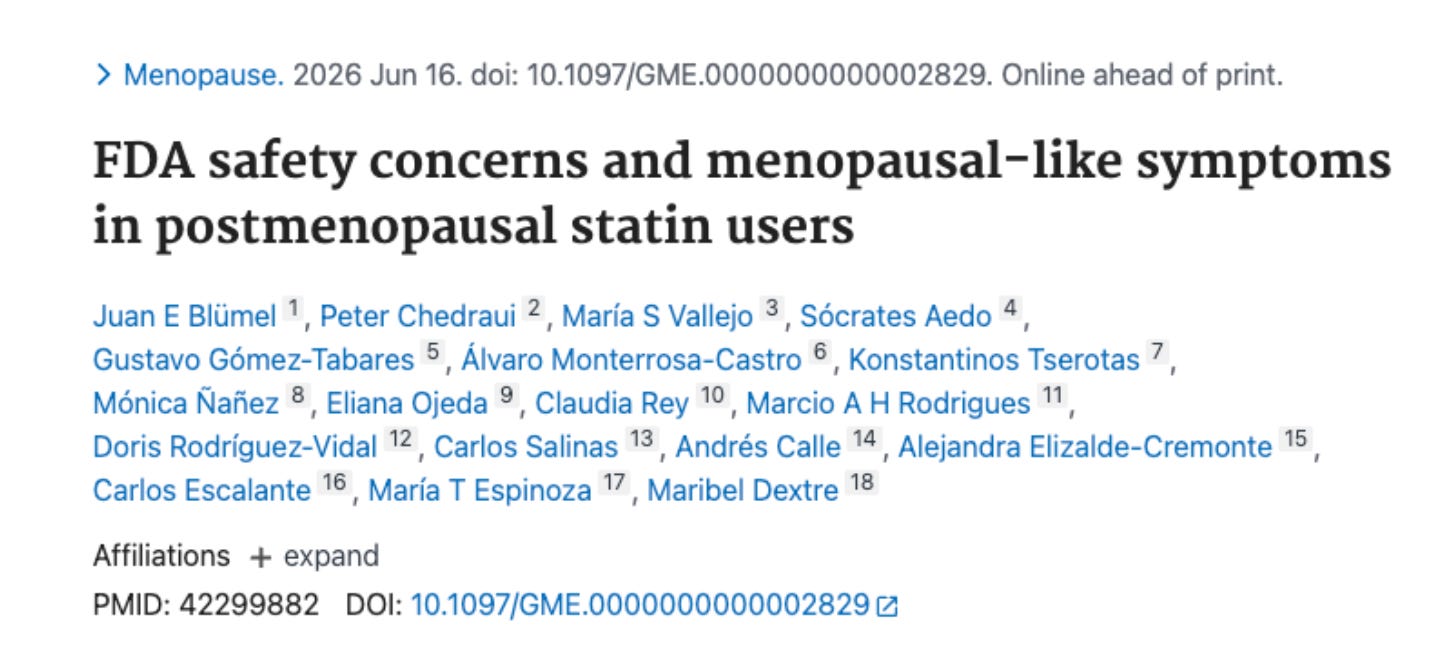
It’s a correlation, not a verdict. A snapshot that can’t prove the statin caused any of it. Fair enough.
But the study isn’t what’s blowing my mind. What’s blowing my mind is what’s not in it, and what’s not in any of them. What’s not being said. Not being studied. Not being taught.
So let me show you instead of tell you.
Imagine a woman dropped into the desert.
Before long, she falls apart. She’s parched, dizzy, aching, foggy. Almost everything going wrong traces to two facts. She has no water, and her whole environment has just changed.
Someone looks her over and notices that one number on her chart has spiked. They come back with a fix. Not water. A pill that brings the number down. Nobody offers her the water first. Nobody notes how much she has left, or whether she has any way to get more. And so nobody can say how her water might change what the pill does, whether it helps her more or less, whether it costs her more or less. They hand her the pill and call it treatment.
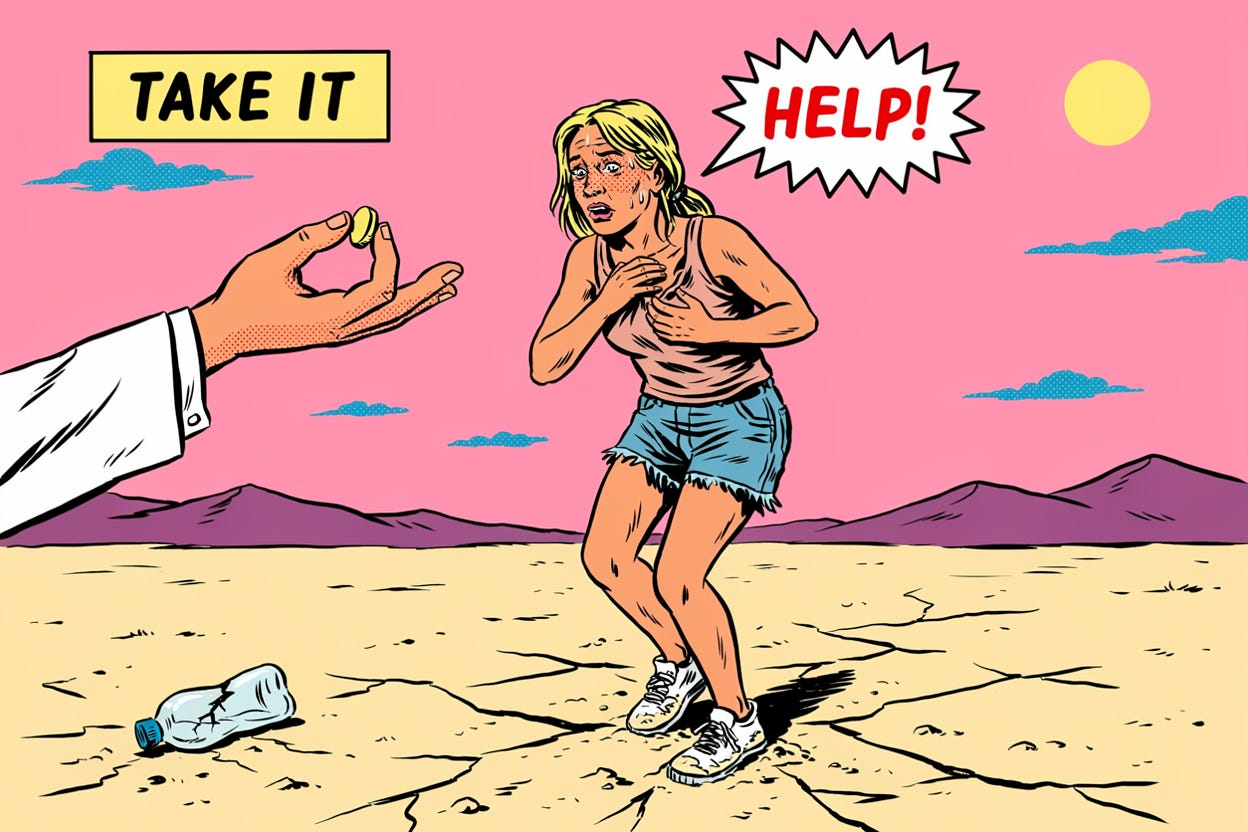
Hold that picture. We’re coming back to it because it isn’t a story about the desert. It’s a description of what we do to women at menopause, and it’s so routine that almost nobody notices how strange it is.
Now here’s the version with your name on it.
You started a statin for your cholesterol. Your doctor called it routine, the kind of thing everyone your age ends up on. And somewhere in the months after, your body got worse. The ache in your hips and shoulders. The bone-deep tired that coffee won’t touch. The fog that makes you read the same sentence three times before it lands.
You mentioned it. You got the shrug. “That’s just aging.”
Maybe it is. But if you asked your doctor whether that cholesterol drug behaves differently in a woman who’s been through menopause, she couldn’t tell you. Nobody could. In fifty years and tens of billions of dollars of research, almost nobody bothered to ask.
Menopause isn’t a mood. It’s a metabolic switch.
We talk about menopause like it’s a weather system. Hot flashes, mood swings, a few rough years, then calm. That framing has done women a tremendous disservice, because menopause isn’t only happening to your temperature and your temper. It’s happening to your metabolism.
Estrogen does quiet, load-bearing work all over the female body, on your blood vessels, your blood sugar, your inflammation, the little power plants inside your cells. When it leaves, all of that shifts at once.
Your lipids are the clearest example, and we can watch it happen in real time. In the SWAN study, researchers followed women throughout the transition and tracked their lipid levels year by year. The finding that matters: total cholesterol, LDL, and ApoB don’t drift up gradually with age the way you’d assume. They catapult up, sharply, in the narrow window right around your final period. The pattern doesn’t fit aging. It fits menopause.
The menopause transition is, for a lot of women, the event that creates the high cholesterol in the first place. Your numbers were fine. Then your ovaries clocked out, your LDL climbed, and a few visits later, you walked out with a prescription. Menopause didn’t just hand you hot flashes. It rewrote your cardiovascular risk profile. To see how completely, you have to look at what estrogen was doing before it left.
Estrogen was the drug all along
We file estrogen under periods and fertility and, later, hot flashes. But quietly, in the background, it’s been running your cholesterol the entire time. It tells your liver to keep more LDL receptors on duty, the little vacuums that pull cholesterol out of your blood. It restrains PCSK9, the protein whose whole job is to tear those vacuums down. (When estrogen falls at menopause, PCSK9 climbs about 22%, and cholesterol pools in your blood.) It dials down how much cholesterol your gut absorbs from food. That’s a statin, a PCSK9 inhibitor, and ezetimibe, three separate blockbuster drug classes, all at once, for free, through her own receptors, every year she was cycling.
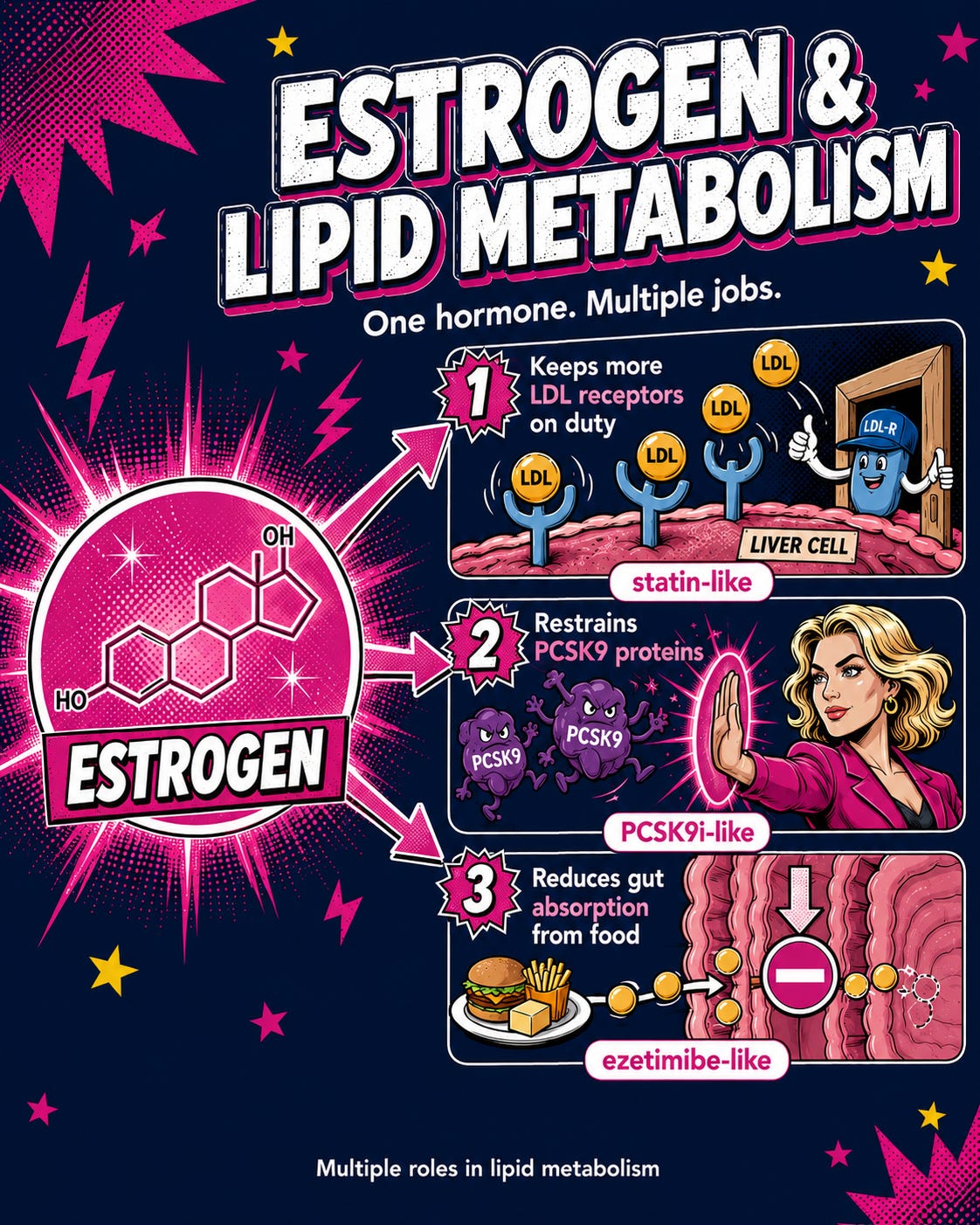
Estrogen isn’t the only hand on the wheel, of course. Aging plays a part, so do weight, thyroid, insulin, and a handful of other hormones. Estrogen is the conductor of this orchestra, not a soloist. But when it steps off the podium, the whole ensemble drifts out of tune. It’s the most far-reaching lipid drug a woman will ever take, and the only one nobody refills when it runs out.
Look at the size of this thing.
So let’s talk about the statin.
When estrogen runs out, we don’t replace it. We reach for a manufactured version of one of its jobs, at a scale that’s hard to picture.
Statins are one of the most prescribed medications in the history of medicine. In the United States alone, they ran about $10 billion in 2019, with more than 800 million prescriptions filled a year, and atorvastatin, just one statin among several, is perennially one of the most prescribed drugs in America. A lot of those scripts go to women like you. Statin use among American women over 40 rose from about one in six in the early 2000s to one in four by the early 2010s, and it climbs with age. Somewhere between a quarter and a third of older American women are on a statin. Tens of millions of postmenopausal women, every day, for years.
Built on women, blind to menopause
Although women make up about a quarter of the people in statin trials, no major lipid-lowering trial, old or new, has ever recorded menopausal status or hormone therapy use as a variable to analyze.
None.
Not whether a woman was menopausal, not for how long, not her estrogen level, not whether she was taking hormones. The thing you just watched run the entire lipid system got treated like it wasn’t in the room.
There’s a word for a variable you fail to measure that quietly bends your result. A confounder. Estrogen is the confounder nobody measured, and it doesn’t bend in just one direction. It plausibly changes how well a statin works and how hard it hits, both at once. Leave it off the chart, and every clean number that came back is a little less clean than it looks.
The one big trial that engaged with hormone therapy at all, JUPITER, did so for a single purpose: to throw out every woman taking it. Not to learn whether estrogen mattered. To make sure it couldn’t. So the obvious question just sat there, unasked. Does a woman’s estrogen status change how well a statin works, how she tolerates it, or what it costs her?
Someone did look, once, a long time ago. In the late 1990s and early 2000s, a scatter of tiny studies (a couple dozen women at a time, a few weeks apiece) put estrogen head to head with a statin, and sometimes the two together. The statin did the heavier lifting on LDL. The estrogen did what the statin couldn’t, raising HDL, dropping Lp(a), helping the vessels themselves relax, and together they covered each other’s gaps. But those studies used the old horse-derived estrogens, not the body-identical hormones women take now, and nobody with the money and reach to run a real outcomes trial ever picked the question back up. The signal was sitting right there in the 90s. The field walked past it.
The same footprint
The effects of statins and the effects of estrogen withdrawal overlap in three major ways.
Mitochondrial dysfunction:
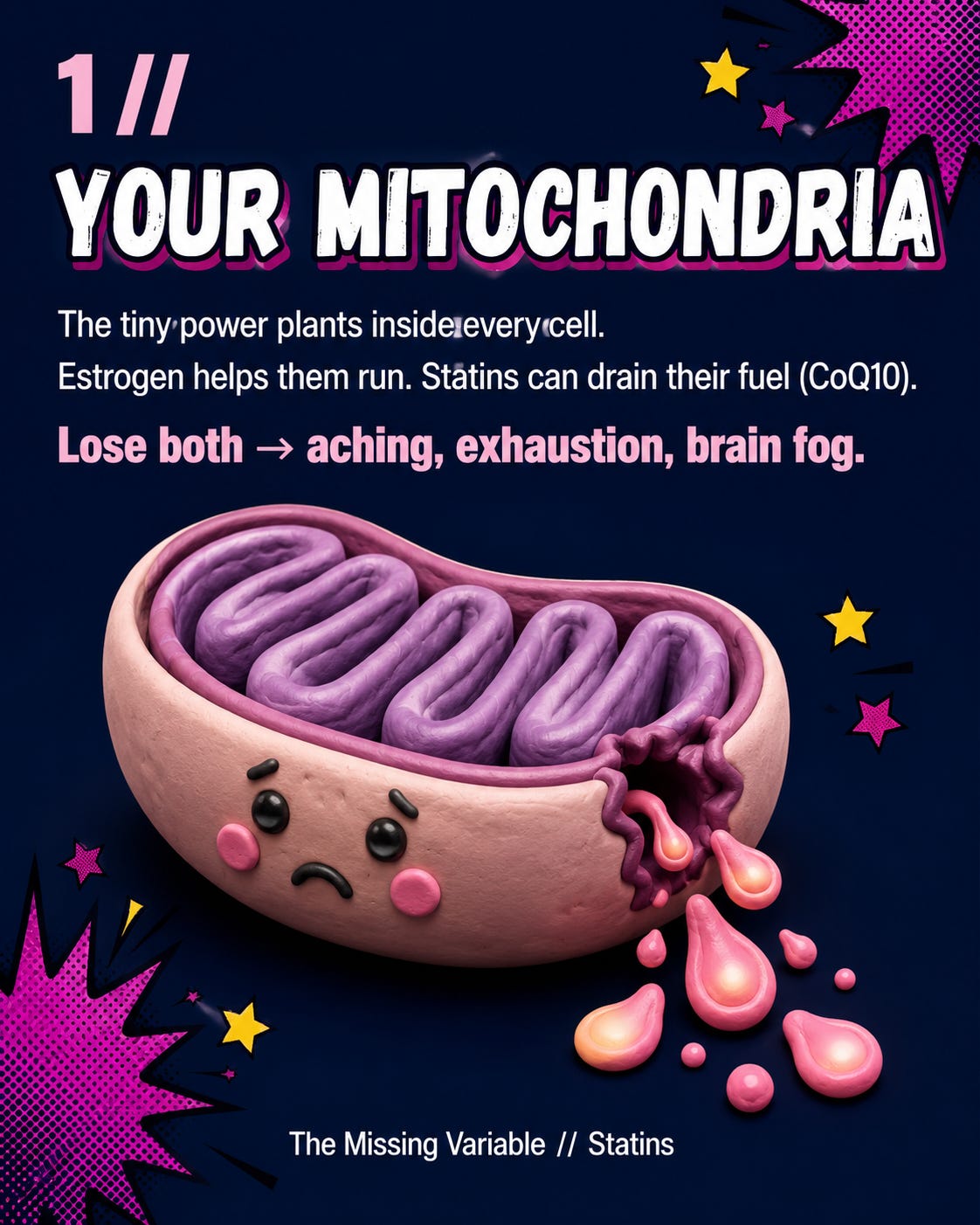
Start with your mitochondria, the tiny power plants inside nearly every cell you have. They turn fuel into the energy that runs you. Two tissues are especially greedy for that energy, and they’re the two that get hit hardest here: muscle and brain. Both run hot, both lean on mitochondria, both fail first when the power dips.
Estrogen helps those power plants run. When you lose it at menopause, they falter. In muscle, that’s aching, and fatigue that sleep doesn’t fix. In the brain, it’s measurable. Lisa Mosconi’s imaging caught the menopausal brain sliding into what she calls a bioenergetic crisis: glucose metabolism drops, and the activity of cytochrome oxidase, a key link in the mitochondrial energy chain, falls with it. That’s the brain fog and the reaching-for-a-word feeling, rendered on a scan. That’s hit number one.
A statin can be hit number two in the same machinery. Statins lower cholesterol by blocking an enzyme early in a production line called the mevalonate pathway. That same line makes CoQ10, a molecule your mitochondria need to turn fuel into energy. Block the line, and CoQ10 can drop right when your muscles and your neurons need it most. The fat-soluble statins cross into the brain more readily, which is part of why cognitive complaints show up at all. So the power plants estrogen loss already weakened take a second hit from the drug.
Insulin resistance:
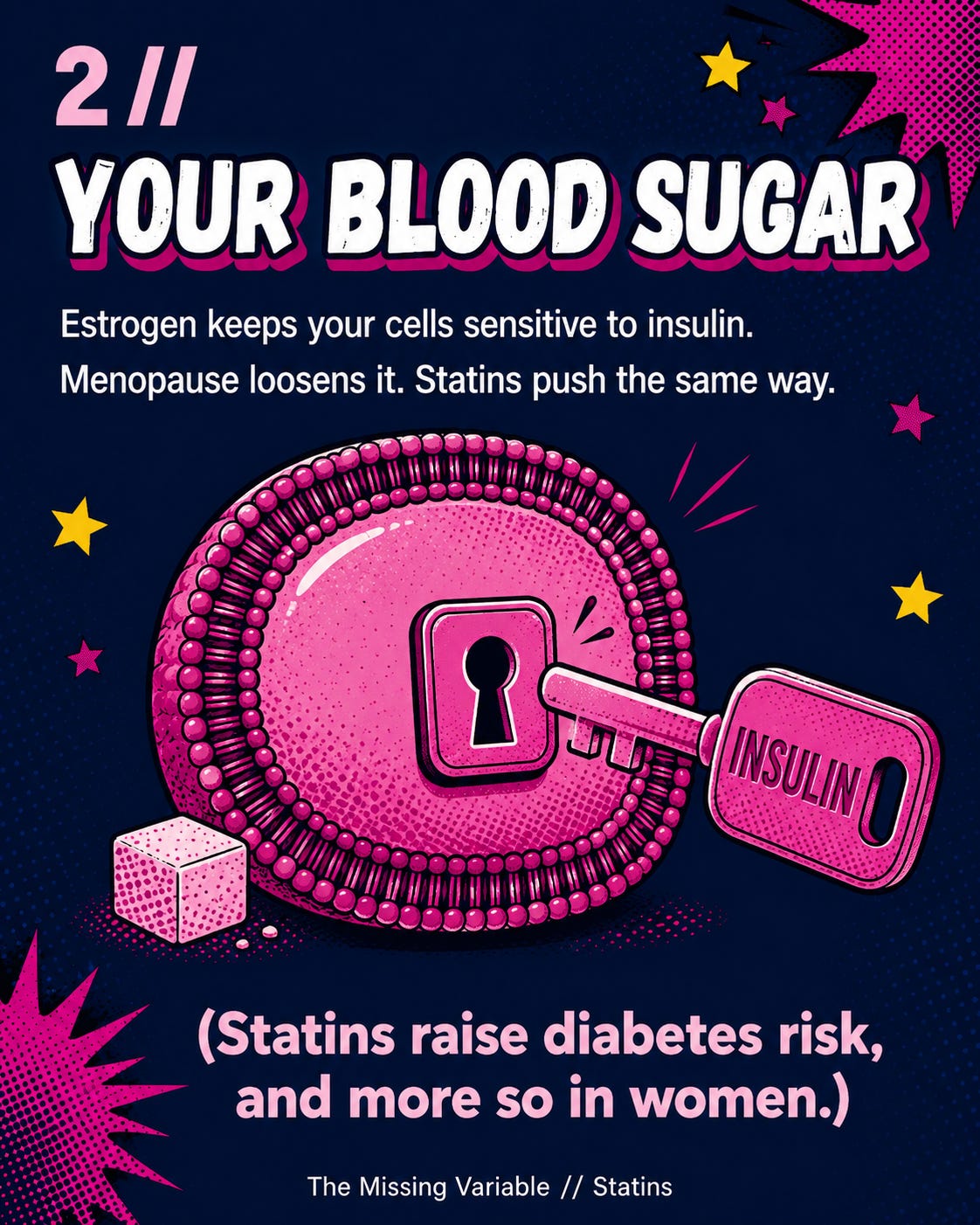
There’s another convergence in your blood sugar. Estrogen helps your cells stay sensitive to insulin. Menopause loosens that, which is part of why your waistline and your glucose start behaving differently in your fifties. Statins push in the same direction, nudging blood sugar up partly through that same tired-mitochondria problem. And this one shows up on the labs: statins measurably raise the risk of new-onset diabetes, and in women that bump runs higher than in men. Two forces, one outcome, in a body that handled sugar fine a few years ago.
Hormone depletion:
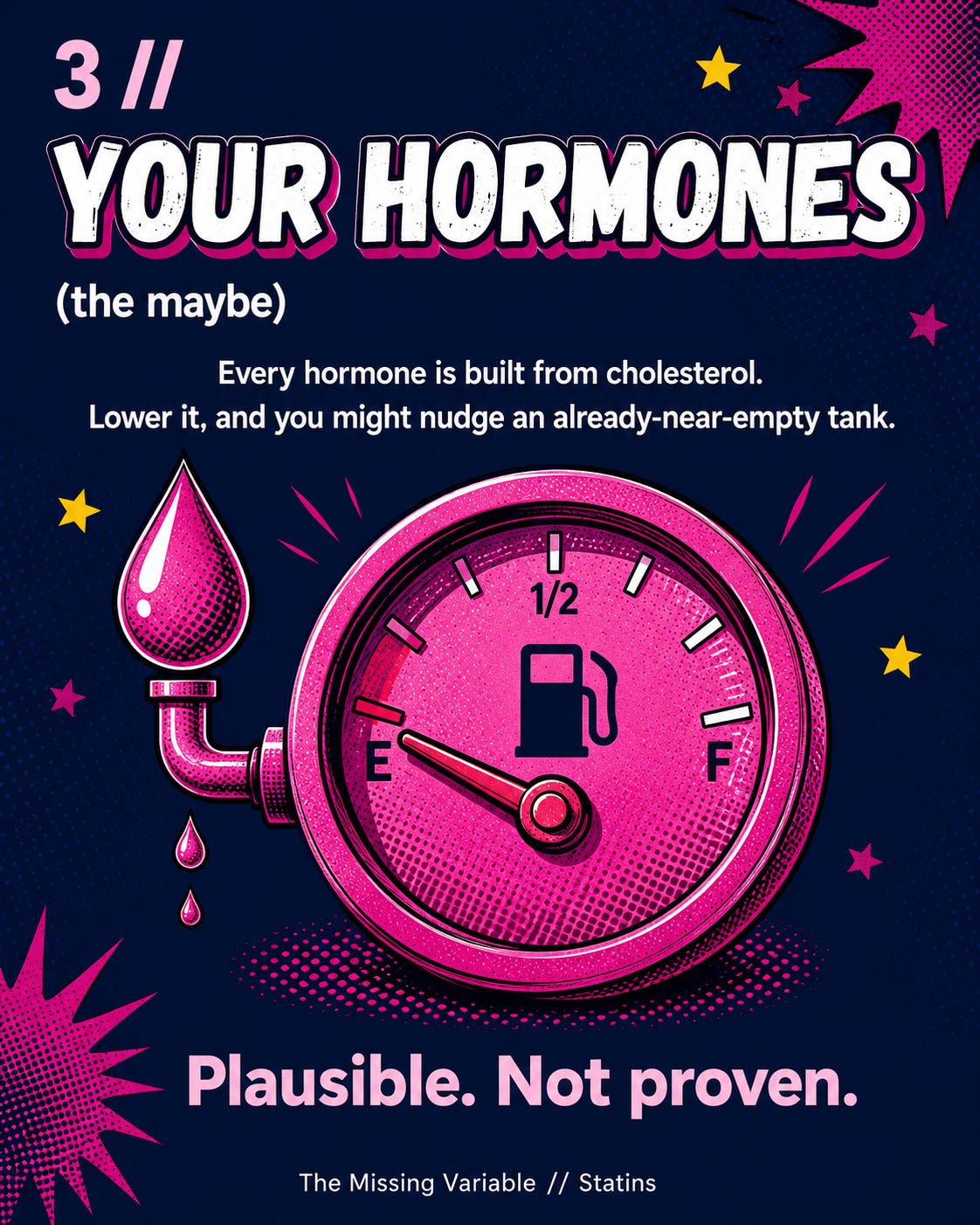
One smaller, separate mechanism, so you have the whole map. Every hormone is built from cholesterol, and in the MESA study women on statins had lower DHEA, a precursor that your tissues turn into trace estrogen and testosterone after menopause. Their measured estrogen and testosterone didn’t drop significantly, so this one’s plausible, not proven. Still, in a woman barely making estrogen to begin with, anything that touches that supply chain can be feel-able.
Put it together, and the same three hits show up whether the culprit is menopause or the statin. Which is why the two lists match. Menopause: brain fog, fatigue, poor sleep, low mood, aching joints, blood sugar creeping up. The statin label, courtesy of the FDA: memory loss and confusion, fatigue, sleep disturbance, mood changes, muscle pain, higher blood sugar. That’s not a coincidence. It’s the same footprint, because underneath it’s the same machinery, hit from both sides in the one population rarely studied.
The study that finally looked
For years, this was all mechanism and patient stories, the kind of thing that gets you labeled an alarmist. Then, in June, 2026, a study in the journal Menopause went looking.
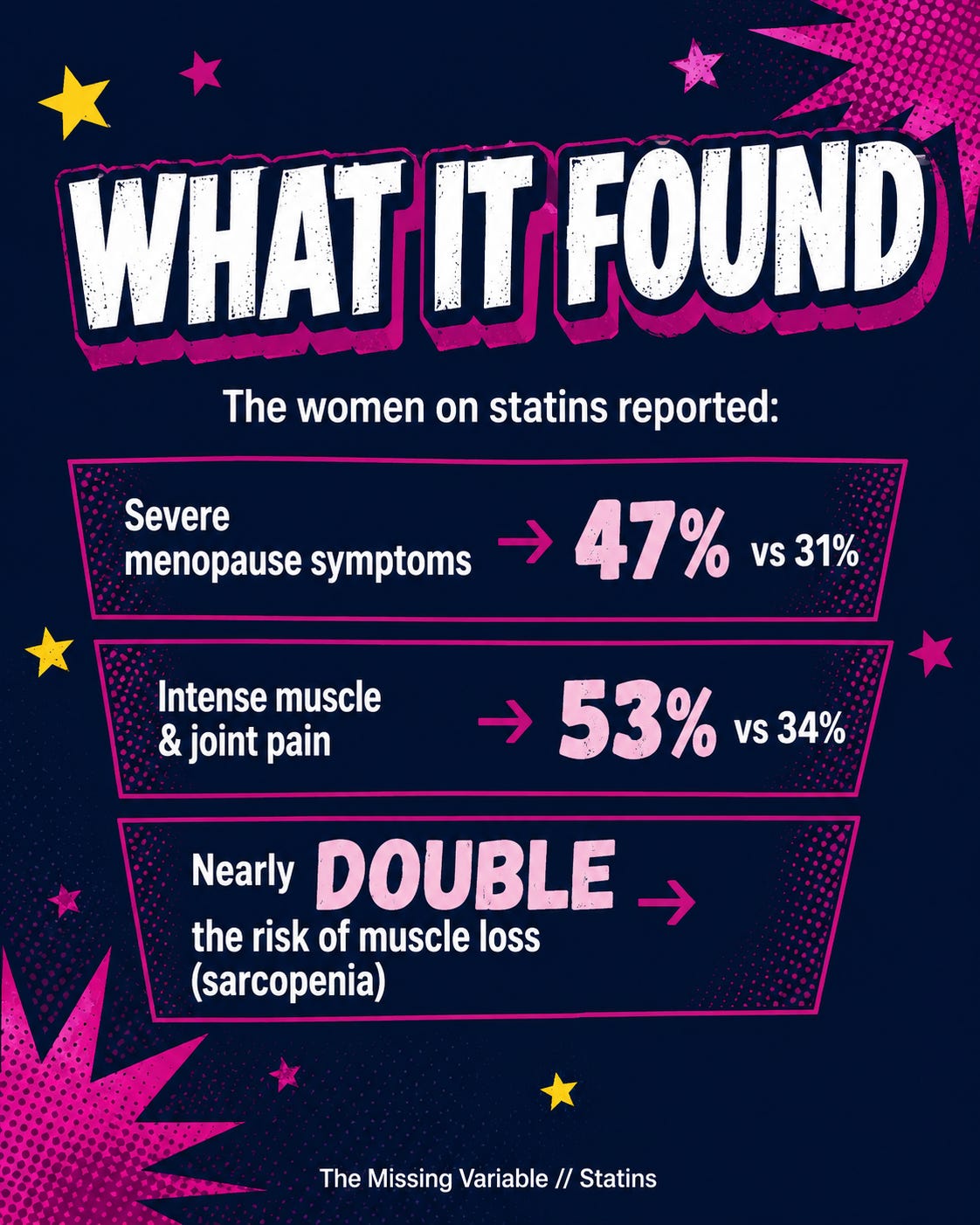
Researchers examined almost 1,200 postmenopausal women across nine countries. About a quarter were on statins. The women on statins were far more likely to report severe menopause symptoms (47 percent versus 31). Far more likely to report serious muscle and joint pain (53 versus 34). Nearly twice the risk of sarcopenia, that muscle loss again. And on cognitive testing, the statin users scored worse on delayed recall and visuospatial tasks, the brain-fog domains, even as their overall score held.
This was a cross-sectional study, not a trial, not proof the statin caused the symptoms, and women on statins may be sicker to begin with. But it’s the first real-world data pointing exactly where the biology said it would. The mechanism predicted the bruise, and someone finally took a photo of it.
So what do you do?
I’m not anti-statin. They have their place. But these are the conversations we should be having, and mostly aren’t, so have this one with your prescriber.
If you’re staying on it, support the systems taking the hit. Estrogen is the obvious lever, since it’s the thing the desert took. Hormone therapy won’t undo statin-induced muscle pain driven by CoQ10 depletion, and no trial has tested it for this exact purpose, but it addresses the root of the metabolic side of the story and pairs well with statins. Beyond that, the unglamorous stuff has the best evidence: combined strength and cardio training improved muscle and mitochondrial measures in statin users without worsening symptoms. CoQ10 is cheap, safe, and worth trying (though the data is mixed). Red light is lovely in theory (known to improve mitochondrial function), but unproven for this, and I use it anyway.
TLDR
We handed a pill to a woman in the desert. Never checked how much water she had. Never asked if she was drinking on the side. And never once offered her a f***ing glass of the actual thing.
Primary source
Blümel, Juan E., Peter Chedraui, María S. Vallejo, et al. “FDA Safety Concerns and Menopausal-Like Symptoms in Postmenopausal Statin Users.” Menopause (2026). https://pubmed.ncbi.nlm.nih.gov/42299882/.
References
Fu, Wei, Xiao-Ping Gao, Sheng Zhang, Yan-Ping Dai, Wen-Jun Zou, and Li-Min Yue. “17β-Estradiol Inhibits PCSK9-Mediated LDLR Degradation Through GPER/PLC Activation in HepG2 Cells.” Frontiers in Endocrinology 10 (2020): 930. https://doi.org/10.3389/fendo.2019.00930.
Herrington, David M., Brian L. Werbel, Ward A. Riley, Benjamin E. Pusser, and Timothy M. Morgan. “Individual and Combined Effects of Estrogen/Progestin Therapy and Lovastatin on Lipids and Flow-Mediated Vasodilation in Postmenopausal Women with Coronary Artery Disease.” Journal of the American College of Cardiology 33, no. 7 (1999): 2030–2037. https://doi.org/10.1016/S0735-1097(99)00128-X.
Matthews, Karen A., Kelly Crawford, Carol A. Chae, et al. “Are Changes in Cardiovascular Disease Risk Factors in Midlife Women Due to Chronological Aging or to the Menopausal Transition?” Journal of the American College of Cardiology 54, no. 25 (2009): 2366–2373.
Mosconi, Lisa, Valentina Berti, Crystal Quinn, et al. “Perimenopause and Emergence of an Alzheimer’s Bioenergetic Phenotype in Brain and Periphery.” PLOS ONE 12, no. 10 (2017): e0185926. https://doi.org/10.1371/journal.pone.0185926.
Ridker, Paul M., Eleanor Danielson, Francisco A. H. Fonseca, et al. “Rosuvastatin to Prevent Vascular Events in Men and Women with Elevated C-Reactive Protein.” New England Journal of Medicine 359, no. 21 (2008): 2195–2207. https://doi.org/10.1056/NEJMoa0807646.
U.S. Food and Drug Administration. “FDA Drug Safety Communication: Important Safety Label Changes to Cholesterol-Lowering Statin Drugs.” February 28, 2012.
Darling, Giselle M., Jennifer A. Johns, Philip I. McCloud, and Susan R. Davis. “Estrogen and Progestin Compared with Simvastatin for Hypercholesterolemia in Postmenopausal Women.” New England Journal of Medicine 337, no. 9 (1997): 595–601. https://doi.org/10.1056/NEJM199708283370903.
Fak, Ali S., Mithat Erenus, Hakan Tezcan, Oğuz Caymaz, Pamir Atagündüz, Sule Oktay, and Ahmet Oktay. “Effects of Simvastatin Only or in Combination with Continuous Combined Hormone Replacement Therapy on Serum Lipid Levels in Hypercholesterolaemic Postmenopausal Women.” European Heart Journal 21, no. 3 (2000): 190–197. https://doi.org/10.1053/euhj.1999.1582.
Herrington, David M., Brian L. Werbel, Ward A. Riley, Benjamin E. Pusser, and Timothy M. Morgan. “Individual and Combined Effects of Estrogen/Progestin Therapy and Lovastatin on Lipids and Flow-Mediated Vasodilation in Postmenopausal Women with Coronary Artery Disease.” Journal of the American College of Cardiology 33, no. 7 (1999): 2030–2037. https://doi.org/10.1016/S0735-1097(99)00128-X.
Koh, Kwang Kon, Crescence Cardillo, Minh N. Bui, et al. “Vascular Effects of Estrogen and Cholesterol-Lowering Therapies in Hypercholesterolemic Postmenopausal Women.” Circulation 99, no. 3 (1999): 354–360.
Vigna, Giovanni B., Paola Donegà, Rosanna Zanca, Angela Barban, Angelina Passaro, Francesco Pansini, Gloria Bonaccorsi, Gioacchino Mollica, and Renato Fellin. “Simvastatin, Transdermal Patch, and Oral Estrogen-Progestogen Preparation in Early-Postmenopausal Hypercholesterolemic Women: A Randomized, Placebo-Controlled Clinical Trial.” Metabolism 51, no. 11 (2002): 1463–1470. https://doi.org/10.1053/meta.2002.35584.
Are you a medical provider? Learn to prescribe hormone optimization therapy with the frameworks, protocols, and confidence you didn’t get in training.
Get Dr. Amy Killen’s Newsletter
Hormones, longevity, and regenerative medicine — straight talk from a physician who actually prescribes it. Free, weekly-ish, no spam.
This article was originally published on Dr. Amy Killen’s Substack newsletter. Subscribe for free to get new posts delivered to your inbox.