
You do not have a “too little wine before sex” deficiency. You do not have a “just relax” deficiency. You do not have a “buy a lace bodysuit and surprise him at the door” deficiency.
If your body has stopped responding the way it used to, if arousal has become elusive and sensation has gone quiet, there may be another explanation. And it may be the most important medical clue your doctor is ignoring.
In Part 1 of this series, we took apart the anatomy lies. In Part 2, we tackled the orgasm and arousal myths (see below)
Now we’re going where these lies hit hardest and where the consequences are the most dangerous: in midlife and beyond. Because the biggest lie women are told about sexual dysfunction isn’t that it’s normal. It’s that it’s not medical.

He gets a cardiologist. She gets a Chardonnay.
This might be the lie that makes me angriest.
When a 50-year-old man walks into his doctor’s office complaining that he can’t get an erection, the standard of care is to check his lipids, blood pressure, inflammatory markers, fasting glucose, and other cardiac risk factors. Erectile dysfunction is treated as a vascular warning sign. A window of opportunity. A chance to intervene before the real catastrophe shows up. This isn’t controversial. It’s medicine 101.
When a 50-year-old woman walks into her doctor’s office and says she can’t get aroused, that sex has become painful, that she’s lost sensation, that her body just doesn’t respond the way it used to? She gets told it’s stress. She gets told to try therapy. She gets handed an antidepressant or “something to take the edge off.”
Same biology. Same risk factors. Same arteries. Wildly different medicine.
Same Pipes, Different Packaging
To understand why this is so dangerous, we have to look at the plumbing.
Arousal, in both sexes, is fundamentally a hemodynamic event. Most people, and sadly many doctors, don’t realize that the clitoris and the penis develop from the same embryonic tissue. They share the same erectile architecture, specifically the corpora cavernosa and spongiosa.
The mechanism of “getting it going” is identical:
-
Nitric oxide is released.
-
Smooth muscle relaxes.
-
Blood flows in.
-
Tissue engorges.
In men, we call this an erection. In women, it is clitoral engorgement, labial swelling, and vaginal “tenting.” Vaginal lubrication is part of this – blood pushes against blood vessels and transudates, essentially doing a presto-chango from blood into clear, slippery fluid as it exits into the vagina.
The key here is blood flow. Arousal should make you think: blood flow.
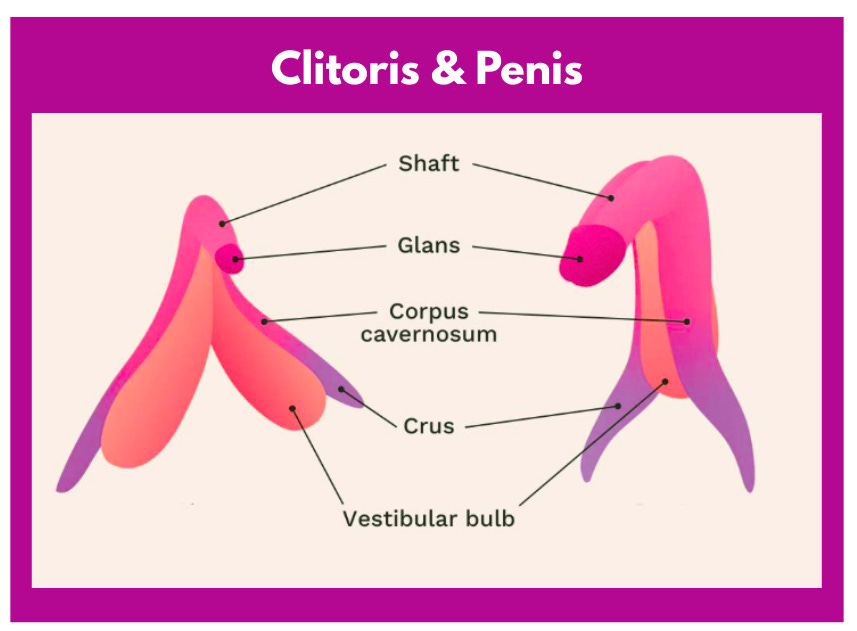
This isn’t a fringe interpretation. The vascular model is well established. The Princeton III Consensus Conference solidified erectile dysfunction as a manifestation of endothelial disease and an early marker of cardiovascular risk. The same physiology applies to women. Goldstein and colleagues named the specific syndromes: vaginal engorgement insufficiency and clitoral erectile insufficiency, both reflecting impaired blood flow through the ilio-hypogastric-pudendal arterial system.
Translation: women get vasculogenic sexual dysfunction. We’ve had a name for it for years. We just don’t diagnose it.
Why female sexual dysfunction (FSD) should be an even earlier warning sign than ED.
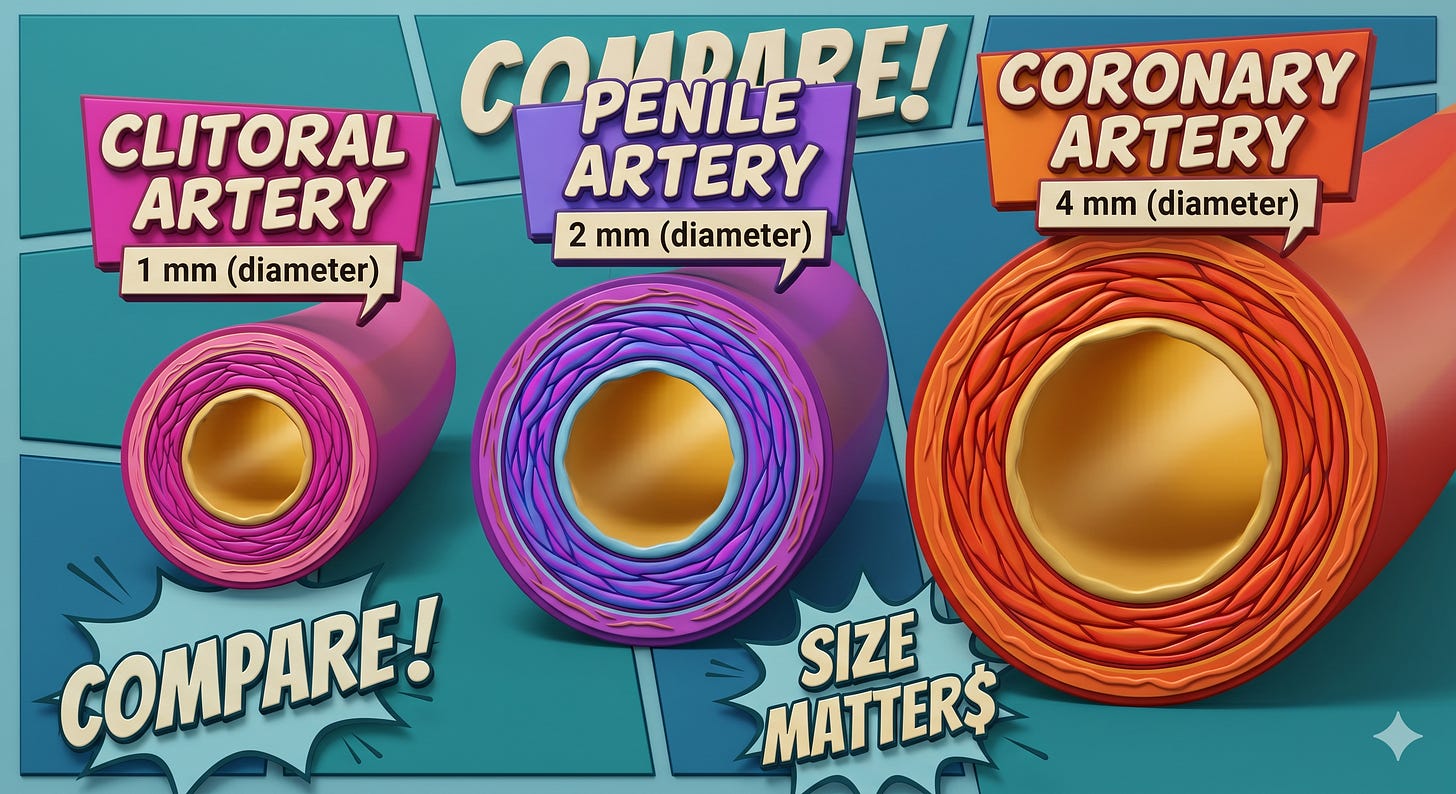
In men, the reason erectile dysfunction (ED) reliably precedes a cardiac event by three to five years is something called the “artery size hypothesis.” The penile arteries are 1-2 mm wide. The coronary arteries are 3-4 mm. Atherosclerosis narrows vessels throughout the entire body, but it shows up first in the smallest pipes. If you put a glob of gum in a garden hose, you might slow the water output slightly, but if you put the same glob of gum into a drinking straw, you’d cut off the flow completely. The same thing happens in the blood vessels in your body.
So a guy who can’t get hard this year is a guy at real risk for an MI (myocardial infarction, aka heart attack) three to five years from now. Plaque in the penile arteries is the canary, an early warning sign that trouble is up ahead.
By the same logic, female sexual dysfunction should be an even earlier warning. The clitoral artery is roughly 0.9 mm. According to the artery-size hypothesis, the clitoral artery should fail first. Before the penis. Before the heart.
The data, as far as it goes, says the same thing. A 2024 meta-analysis of 54 studies and roughly 149,000 women found that women with cardiovascular disease have a 1.5-fold increased risk of FSD. Women with hypertension had 1.4 times the risk. Women who’d had a stroke, 1.8 times. Women who’d had a heart attack had more than two times the risk of female sexual dysfunction (FSD).
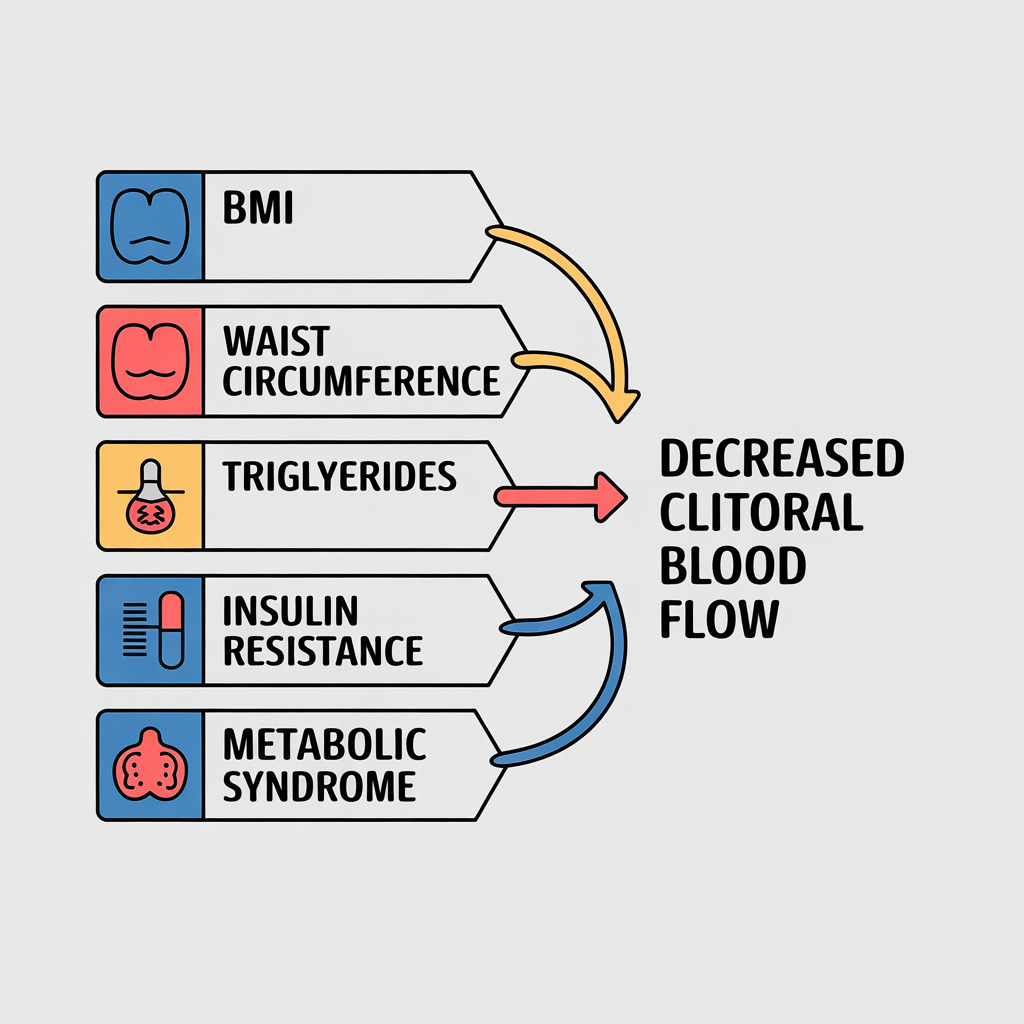
A 2021 study in Scientific Reports used color Doppler ultrasound to measure blood flow resistance in the clitoral arteries of 230 women presenting with sexual symptoms. They found that increased clitoral artery resistance correlated directly with BMI, waist circumference, triglycerides, insulin resistance, and metabolic syndrome. The more cardiovascular risk factors a woman had, the worse her clitoral blood flow.
A 2022 Journal of Sexual Medicine review by Cipriani and Simon laid out the conclusion: female sexual dysfunction may be a mirror of underlying cardiovascular disease, and postmenopausal women presenting with arousal problems should be assessed for both conditions. So when your doctor brushes off your “loss of sensation” or your “less responsive” body, what you may actually be reporting is something about your heart. And no one is listening.
He has guidelines. She has … crickets.
In men, the cardiovascular workup for ED is not a polite suggestion. It’s guideline-level standard of care. The American Urological Association tells doctors, as a Clinical Principle, that men with ED should be counseled that they may be looking at underlying cardiovascular disease. The American Diabetes Association recommends screening diabetic men for ED and evaluating ED patients for cardiac and endocrine risk. The Fourth International Consultation on Sexual Medicine concluded the evidence is strong enough to recommend evaluating any man with vasculogenic ED for occult cardiovascular disease. AUA. ADA. AHA. ICSM. They all agree.
For women? Nothing. No equivalent guideline. No trigger. No flag. The 2024 New England Journal of Medicine review on female sexual dysfunction discusses hormonal, psychosocial, and gynecologic factors and never even mentions a cardiovascular workup. ACOG’s Practice Bulletin doesn’t recommend one either. The most recent comprehensive update on FSD evaluation in the country’s most prestigious medical journal simply does not address whether an arousal complaint should prompt anyone to check a lipid panel.
And doctors in practice aren’t picking up the slack. A 2025 observational study from a large integrated health system found that 41% of men with ED received some form of management. For women with FSD, the number was 33%. When a woman’s FSD was diagnosed by her primary care doctor rather than a specialist, her odds of receiving any management dropped further still. And those numbers aren’t even measuring cardiovascular workups. They’re the rates of patients getting any assessment or treatment for their sexual dysfunction at all. We can’t compare cardiovascular workup rates between men and women because no one has studied it in women.
That’s the guideline disparity. Now meet its shy, ugly sibling.
He has a Doppler. She has a bespoke research project.
If a man’s doctor wants to know whether his ED is vascular, there’s a tool for that. Penile Doppler ultrasound. It’s a validated clinical test, widely described as the cornerstone of the vascular ED workup, and it has established diagnostic cutoffs that tell a doctor whether blood is flowing in normally and staying in long enough for an erection. The AUA guideline includes it as a specialized investigation for the right patients. An international survey of sexual medicine specialists found that roughly 80% of them use it in practice. It’s performed at hundreds of centers worldwide. It isn’t perfect (technique and interpretation vary, and the original validation studies were small), but it is, in every meaningful sense, real medicine. A widely used, clinically actionable vascular diagnostic tool.
The female equivalent exists. Color Doppler ultrasound of the clitoral artery. The technique works. Different ultrasound techs running the same exam get the same results. It produces measurable, reproducible data. The pulsatility index, a measure of resistance to blood flow in the clitoral artery, tracks with cardiometabolic risk factors and with how women score their own arousal on validated questionnaires.
But there’s no agreed-upon threshold for what counts as a normal result versus an abnormal one. No data on how often the test catches real disease or rules it out. No long-term studies tracking whether women with abnormal results go on to have heart attacks. The largest clitoral Doppler study ever published enrolled 230 women at one center. Most of the world’s literature on the technique comes from a single research group in Florence, Italy. ACOG doesn’t mention it. The NEJM review doesn’t mention it. No guideline in the United States recommends it for anything.
Let that sink in. The biology is identical. The technology is identical. The instrument is literally the same machine in the same room. No one has bothered to validate it for women. Penile Doppler is medicine. Clitoral Doppler is a research curiosity being tinkered with between rounds of pasta bolognese at a clinic in Italy.

Why this happens.
We could get into all of the disparities between how medicine handles men’s vs. women’s sexual health. The research funding gap. The medical education gap. The fact that I can’t use the word “vagina” on social media without getting a cautionary message about how my post violates “community guidelines.”
But instead of rage-bait, I’m hoping a simple explanation of what we know and how we could do better will be enough to change how we practice. Not in five or ten years when the research catches up. Today. Right now.
That means when a woman over 40 presents with new-onset arousal dysfunction, decreased sensation, or loss of lubrication that isn’t explained by medication side effects or hormonal changes alone, her doctor should be running a metabolic panel. Lipids. Fasting glucose. Insulin. Blood pressure. hsCRP. HbA1c. The same workup we’d do for a man with ED. Not because sexual dysfunction is always vascular, but because it can be, and ruling it out should be standard of care.
A quick note before I close. Last month, in my article “Please Mind the Gap,” I got a couple of comments from men that are worth mentioning. One said that while the information was useful, he “sensed a bit of feminist resentment.” Another said it was “just another ‘how can we turn men into villains, women into victims’ essay.” I found those comments strange but telling. I was explaining the untruths we’ve been told about the G-spot and why penetrative sex doesn’t do it for all women, and some readers heard “men can’t find the G-spot and suck at sex.”
Let me be clear. I’m not blaming men for the piss-poor workup and treatment of female sexual dysfunction. I’m blaming medicine in general. Me included. I do cardiovascular risk assessments on all of my patients, but I’m not out there doing bedside clitoral Doppler ultrasounds every time a woman tells me things don’t feel like they used to. We can all do better.
And if you hear “men suck” every time I say “women deserve better,” you may very well be part of the problem. Just saying.

This was Part 3 of a monthly series on Sex. I have had such amazing comments and engagement with this limited series, I’m planning to make it a regular. What topics do you want me to write about in future Substack articles? Comment below.
Medical providers… if you want to learn more about prescribing hormones for men and women from someone who’s been doing it for >13 years, check out my Provider Course and Free Quick-Start Guide below.

References
Burnett AL, Nehra A, Breau RH, et al. Erectile Dysfunction: AUA Guideline. J Urol. 2018;200(3):633–641.
Cipriani S, Simon JA. Sexual dysfunction as a harbinger of cardiovascular disease in postmenopausal women: how far are we? J Sex Med. 2022;19(9):1321–1332.
Dillxiatl D, Dillyaer. Association between cardiovascular disease and risk of female sexual dysfunction: a systematic review and meta-analysis. European Journal of Preventative Cardiology. Jan 2024.
Goldstein I, Berman JR. Vasculogenic female sexual dysfunction: vaginal engorgement and clitoral erectile insufficiency syndromes. International Journal of Impotence Research. 1998;10(Suppl 2):S84–S90
Islam RM, Bell RJ, Green S, Page MJ, Davis SR. Safety and efficacy of testosterone for women: a systematic review and meta-analysis of randomised controlled trial data. Lancet Diabetes Endocrinol. 2019;7(10):754–766.
Maseroli E, Fanni E, Cipriani S, et al. Cardiometabolic risk and female sexuality: focus on clitoral vascular resistance. J Sex Med. 2016;13(11):1651–1661.
Maseroli E, Vignozzi L, Reisman Y. Clitoris color Doppler ultrasound: a 2023 update. J Sex Med. 2023;20(12):1367–1368.
Parish SJ, Simon JA, Davis SR, et al. International Society for the Study of Women’s Sexual Health clinical practice guideline for the use of systemic testosterone for hypoactive sexual desire disorder in women. J Sex Med. 2021;18(5):849–867.
Park K, Goldstein I, Andry C, et al. Vasculogenic female sexual dysfunction: the hemodynamic basis for vaginal engorgement insufficiency and clitoral erectile insufficiency. Int J Impot Res. 1997;9(1):27–37.
Princeton III Consensus Conference – Nehra A, Jackson G, Miner M, et al. The Princeton III Consensus recommendations for the management of erectile dysfunction and cardiovascular disease. Mayo Clin Proc. 2012;87(8):766–778.
Scavello I, Maseroli E, Cipriani S, et al. Cardiometabolic risk is unraveled by color Doppler ultrasound of the clitoral and uterine arteries in women consulting for sexual symptoms. Sci Rep. 2021;11:18899.
Are you a medical provider? Learn to prescribe hormone optimization therapy with the frameworks, protocols, and confidence you didn’t get in training.
Get Dr. Amy Killen’s Newsletter
Hormones, longevity, and regenerative medicine — straight talk from a physician who actually prescribes it. Free, weekly-ish, no spam.
This article was originally published on Dr. Amy Killen’s Substack newsletter. Subscribe for free to get new posts delivered to your inbox.