

“Why is the f’##kng parking garage so hard to find? I circled the block four times before I finally found it. Who puts their parking garage across the street from their building instead of under it? What kind of practice are you running here, anyway?”

That was the first thing Bonnie from Portland said to me when I met her at the door of my new, shiny bioidentical hormones and integrative medicine office in 2013. She was one of my first patients, and she was not happy. I had apparently put the parking lot too far from my office, and that had ruined Bonnie’s day. And, she was about to try to ruin mine.
I knew nothing about running a medical practice. I’d spent 10 years in the emergency department, where all you have to do is show up at the allotted time and get to work. I was used to people cussing at me (spitting at me, kicking at me), but I wasn’t used to running a medical practice, a place where people paid hard-earned cash to see me. A place where something as random as a parking garage one block from my office made the difference between a repeat customer and a bad Yelp review.
I didn’t have a receptionist or nurse. I didn’t have a medical assistant. I didn’t have anybody to absorb the brunt of Bonnie’s displeasure with the world around her (and my office, more specifically). It was just me, a lone physician with a new medical practice. How in the hell had I gotten here?
Two years before, in 2011, I’d seen an ad in an in-flight magazine of a muscled-up physician named Dr. Jeffrey Life. The ad was titled “How does this 73-year-old have the body of a 30-year-old,” and it talked about reducing the risk of age-related diseases using a combination of nutrition, exercise, and hormone optimization.
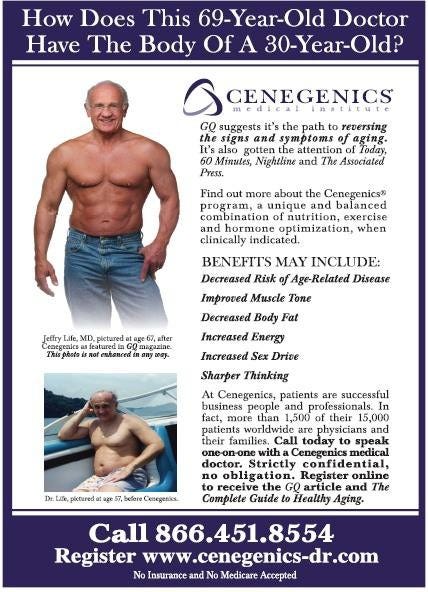
At the time, I was an emergency physician, working 4:00 am shifts in the ER so I could be home with my three kids in the evenings. They were 3, 3, and 1, and I barely had time to eat and shower most days, let alone hit the gym or prepare nutritious food. Dr. Life’s ad for Cenegenics (his clinic) mesmerized me and was the first time I considered that there might be another way to practice medicine. Was it really possible to be proactive instead of reactive? Was there a role for hormones I’d barely heard of in helping people look and feel good now while also reducing future disease risk?
Shortly after, I found myself on the phone with a physician from Cenegenics. He was an anesthesiologist who had been practicing this “age management medicine” for several years. I vividly remember my first call with him. He asked me what I knew about estrogens like estradiol, estriol and estrone? I had literally never heard of these things before (I just knew that “estrogen” was dangerous and caused breast cancer!). He asked me what I knew about perimenopause and menopause. Again… blank. What about VO2 Max testing as a marker of cardiorespiratory fitness? Nope. Thyroid optimization? Negative Ghostrider. I didn’t know about any of it. It sounded like voodoo witch doctor stuff to me. But my mind kept flashing back to that picture of Dr. Life. He must be doing SOMETHING right.
Before long, I’d traveled to Las Vegas for an intensive 9-day training course in age management medicine. I drank from the firehose during the day, then joined the instructor at his Krav Maga class in the evenings. I remember being quite bruised, yet incredibly exhilarated. The stories he told about the impact of these hormones were insane!
After I finished my Cenegenics course, I wasn’t ready to see my own patients, so I enrolled in a fellowship program through A4M called “Anti-Aging and Regenerative Medicine.” It required multiple long weekends away at conferences, as well as hundreds of hours of self-paced study, before finally sitting for the in-person written and oral board exams. Now, this “fellowship” was not (and still is not) recognized by the Accreditation Council of Graduate Medical Education (ACGME), but it provided a decent foundation and gave me the audacity to eventually leave emergency medicine.
When I told my ER colleagues I was leaving to open a practice focused on bioidentical hormones and lifestyle medicine, they laughed at me. One thought I was opening a medspa and asked if I could get her a good deal on Botox. Another told me I was “no longer a real doctor.” But, I didn’t care. I’d seen the light. Or, I’d seen a glimmer of what was to eventually be the light.
I packed up and moved my family from Austin to Portland, Oregon. I found an office, bought a bright blue rug and white pleather couches for the waiting room, and figured out how to run a phone intercom even though I was the only person in the office for the first 6 months. Paging Doctor Killen…

Then, Bonnie walked in, dropping F-bombs about the parking garage and asking why she’d had to walk a block and ride an elevator to get to my third-floor office. I eventually got her to calm down (can I get you some tea?) and she told me her story. She was 52 years old and felt like her life was falling apart. She’d gained 30 pounds in the last three years. She got tired walking up two flights of steps. She woke up 4-5 times each night in a sweat and was about to lose her job at the law firm because she couldn’t focus for more than ten minutes. She told me she didn’t recognize the person in the mirror, and she was just so, so mad.
She told me she didn’t recognize the person in the mirror, and she was just so, so mad.We talked for an hour. I gave her more tea and listened as we reviewed her extensive lab results. I told her what I saw. She was in menopause with a rock-bottom estradiol and progesterone. Her testosterone was also low. Her insulin and cortisol were high. She was pre-diabetic and inflamed, putting her at risk for heart disease (the number one killer of women). At the end of it, I recommended she start hormone optimization therapy, including estradiol cream, progesterone pills, testosterone cream, and low-dose desiccated thyroid. I added a few supplements, including Vitamin D3 with K2, Magnesium glycinate, and omega-3 fatty acids. I told her it would be okay, even though I didn’t really know that for sure. I was new at this and just followed the lessons others had given me.

Three months later, Bonnie came back to my office.
She walked through the door wearing this long, ornate kimono-type thing. She’d taken the stairs, and she was beaming. I remember looking from her red kimono to her smile and wondering if she’d intentionally matched her lipstick with the kimono print. She hugged me, right there in the lobby, before we’d even had a chance to grab tea. She told me she’d thought she was lost for good but that she’d found herself in the three months since we’d met. She’d lost 15 pounds and was sleeping most of the night. She’d started walking three miles a day. And, most importantly, the red haze of rage that had been obscuring her thoughts and vision was gone. She no longer fumed at the way her husband turned on the blinker a half-mile before the turn. She was starting to see herself again.
Bonnie was my patient for several years. She showed up every three months to review labs, tweak doses, and talk about how she was doing. We dialed back her testosterone when her leg hair got too dark (”I look like a man when I wear shorts!”). We increased her progesterone when she had some vaginal bleeding, after making sure it wasn’t anything serious. We tried three nutrition plans before we found one she could stick with. It wasn’t a “one and done” kind of thing, but with each step forward and half-step back, she remained fully present and fully herself.

I sometimes think about that in-flight magazine ad that started all of this. Dr. Jeffrey Life is apparently still going strong at 87 (at least according to his Instagram). I never met him, by the way. I never told him what a difference he made in my life or in the lives of women like Bonnie. Maybe he’ll read this, and he’ll know. I hope so.
Since 2013, I’ve seen thousands of Bonnies, each with their own story and struggles. Each requiring different doses of hormones and lifestyle levers. To say I’ve “figured it out” would be an overstatement. Any hormone doctor who says they know it all is kidding themselves and you. But, I’ve seen enough now to know that Bonnie was not a fluke. Her story was not a one-off. These hormones, which were vilified and spat upon by allopathic medicine for twenty-plus years, are game-changers. Life-savers. And thousands of women walking around in red kimonos, finally recognizing themselves again, are proof.
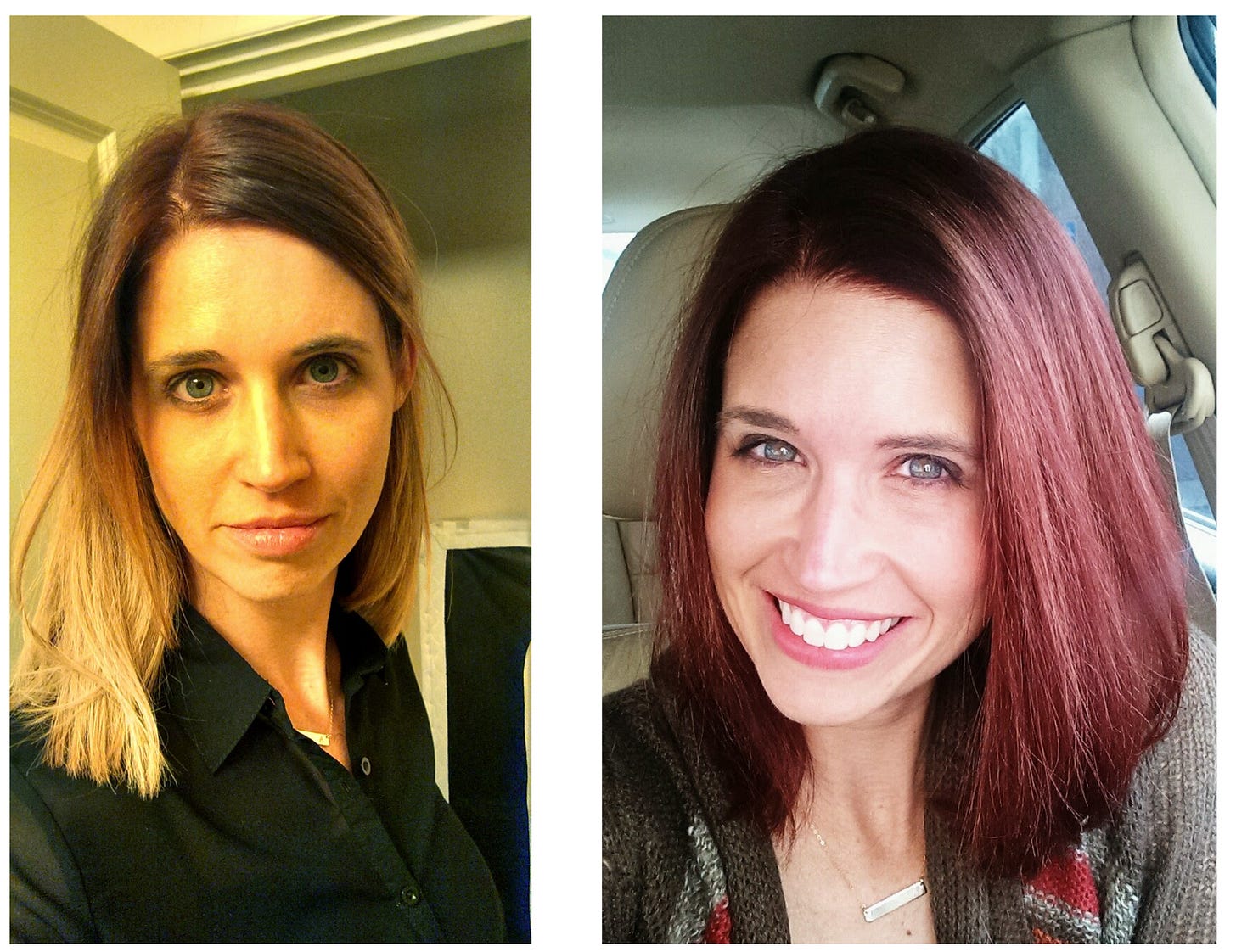
P.S. This might be a good time to tell you about my Red Hair Phase, which happened shortly after Bonnie’s epic transformation. I’d always loved dark red hair so decided to give it a try that winter. I went to a salon and told them what I wanted. The stylist was nervous so only dyed my roots red initially, leaving me with a weird two-tone situation. I eventually went back and got the whole thing done and was a red-head for a year. 2013-14 was an era of trying new things for all of us!
This article was originally published on Dr. Amy Killen’s Substack newsletter. Subscribe for free to get new posts delivered to your inbox.
Are you a medical provider? Learn to prescribe hormone optimization therapy with the frameworks, protocols, and confidence you didn’t get in training.
Get Dr. Amy Killen’s Newsletter
Hormones, longevity, and regenerative medicine — straight talk from a physician who actually prescribes it. Free, weekly-ish, no spam.